Tuesday, September 20, 2016

Images from the 39th Suzuka 8 Hours, Part Five ...

Images from the 39th Suzuka 8 Hours. For the full story of the race and more images, purchase the book  at:

http://thebp.site/87100

High-res versions of the images in the book or posted here also are available on a donation basis. Paypal a donation to morbidelli17@yahoo.com and receive the hand-edited full-resolution image or images of your choice in your mailbox.

At the other rounds of the FIM Endurance World Championship, they were the rock stars. At Suzuka, they were the Nowhere Men, the supporting cast, performing an ancillary storyline. They were the FIM EWC permanent teams, fighting among themselves for the few points on offer after the local squads had eaten their fill. Here Team SRC Kawasaki, which won the Bol D'or 24-hour race earlier in the season, sits ignored before the start of the 8 Hours.


Suzuki Endurance Race Team's EWC GSX-R1000 and the Moto Map Supply GSX-R1000 fly in formation. Moto Map, which competes in the MFJ Superbike series in Japan, finished fifth; SERT crashed and was out of the points.


Team SRC's Kawasaki DNF'd.
GMT94 suffered a mechanical early and was able only to climb back into 14th. It would prove costly in the final EWC Championship tally.
 
The local teams put on a production on the pre-grid. On this day, at this circuit, the front-line local teams were the rock stars.


Friday, September 16, 2016

Images from the 39th Suzuka 8 Hours, Part Four

Images from the 39th Suzuka 8 Hours. For the full story of the race and more images, purchase the book  at:

http://thebp.site/87100

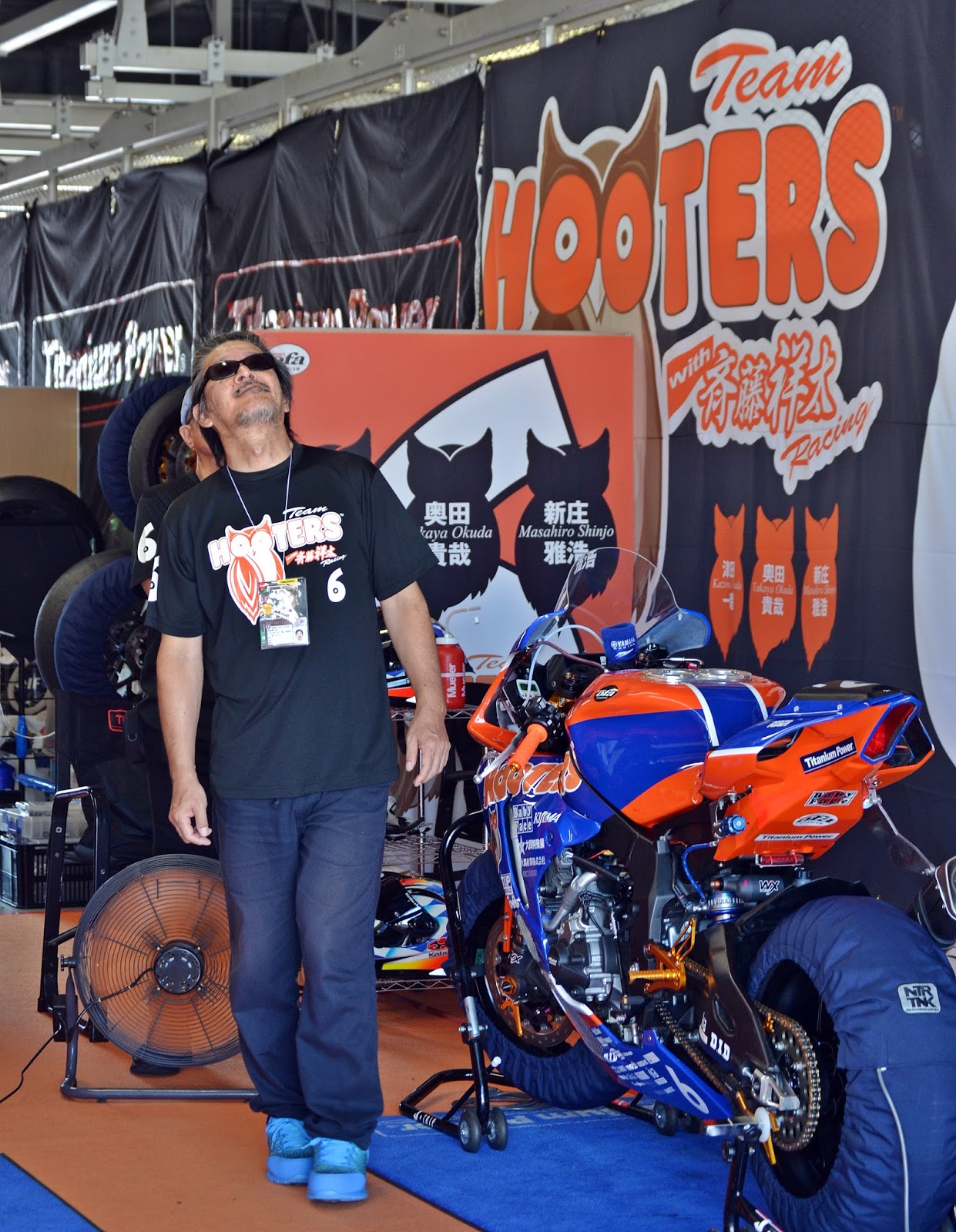
Apparently there is a rule that at every motor race, anywhere in the world, someone must run Hooters livery. Masahiro Shinjo on the Team Hooters Yamaha YZF-R1.


Flower Power - The Sakura Project Kawasaki ZX-10R with Hidemichi Takahashi aboard.

Flower Power programmer. Awesome hair.


Takumi Takahashi on the MuSASHi RT HARC-PRO Honda CBR1000RR.

Monday, September 12, 2016

Images from the 39th Suzuka 8 Hours, Part Three

Images from the 39th Suzuka 8 Hours. For the full story of the race and more images, purchase the book  at:

http://thebp.site/87100

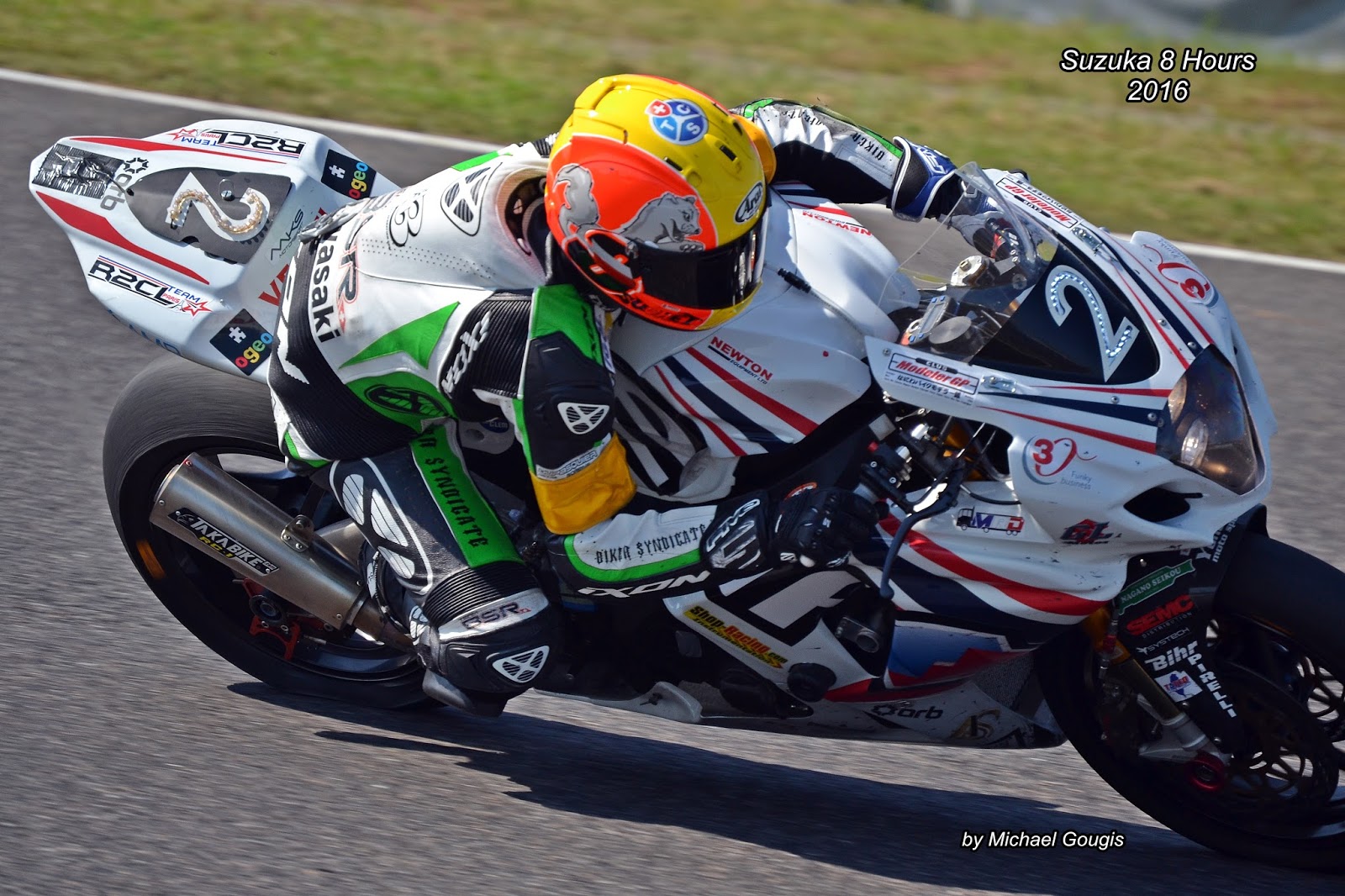
This shot is the wraparound front and back cover image from a special edition of the book that I had printed for a few clients. One of the most enjoyable things about detailed photographs is that they tell a rich and complex tale on their own. This is the Team R2CL Suzuki GSX-R1000 with Sebastien Suchet aboard. A permanent but lesser-funded team in EWC competition, its GSX-R1000 is not really competitive with the front-line Suzukis of Suzuki Endurance Racing Team and wasn't even in the horsepower ballpark with the Yoshimura and Team Kagayama GSX-R1000s at Suzuka. Team R2CL claims only 180 horses for the machine, which it lists as a 2013 model. The shot shows the less-expensive, last-generation Ohlins forks clearly, and what appears to be the backyard light string used to generate the illuminated "2" on the tail section. My favorite detail in this shot involves Suchet's leathers. Suchet was racing a Yamaha YZF-R1 in the Superstock World Championship in 2016, so he couldn't use the leathers from that team on the Suzuki. Team R2CL couldn't afford to get him new leathers for the 8 Hours. So he pulled out a set of leathers from last year, when he raced a Kawasaki ZX-10R in World Superstock. Tape was slapped over the "Kawasaki" nomenclature. But hours of the heat, humidity and speed of racing at Suzuka weakened the adhesive. Look just above Suchet's bum and you see the tape peeling away, revealing the letters "asaki." Low-budget, perhaps. But the team ran a quick, steady race, avoided mistakes and beat a lot of the big-name permanent EWC teams in the 8 Hours.

Thursday, September 8, 2016

The Edge Of Madness, And Why Living There Is Important ...


The Can-Am sports car race at Road Atlanta in July 1971 was not a good race for Formula One World Champion Jackie Stewart. The Can-Am series paid good money, more than F1, so Stewart flew across the ocean regularly to hustle a fat Lola sports car around North American circuits. 

On this day, he earned his money. 


A flat tire and a struggle to re-start the car after the pit stop dropped him to 21st, three laps down. Stewart went back out. The brakes started to fade and the right front wheel wore a big hole in the top of the fender, showering him with tire and bodywork debris. He came back into the pits, went back out and set the race's fastest lap time - 1.3 seconds better than he'd done in qualifying and 0.3 seconds quicker than pole. The car finally broke for good. When asked why he was driving so hard when there was absolutely no hope of a win, a podium or even points, Stewart said:

"Ooch! Ye must never let y'self fall into the habit o' drivin' at anythin' less than yer maximum!"

The saying is that consistency wins championships. Like many other things in life, that saying is partly true. It obscures a deeper truth. What really wins championships is speed. At the end of the day, to seize a championship requires the racer to finish higher up the order than the other riders, race after race. Slower riders do not win races. They are gifted wins when faster riders falter. Occasionally it happens often enough in a short enough period of time that a championship goes to a slower rider. That is one of the joys of watching motorsport. 

But more often than not, speed gives you a better chance of finishing higher. Speed keeps you out of trouble, prevents you from fighting with mid-packers as you try to get to the front after starting from the third row. Speed puts you ahead of your competitors on the track. All other things being equal, the faster rider/bike combination wins the race more often. And even though all other things never are equal, pure speed gives you more of a chance to take the win rather than inherit the win. As a competitor, you don't prepare to inherit wins. You prepare to beat the others. Yes, most of us would rather be lucky than good. But you can't control luck. You can control speed.

Talent makes you fast. Experience keeps you fast. There's a reason that riders are slower when they come back from the off-season for the first tests of the new year. They're not less talented. They're further from the last time they experienced riding on the edge. They're not as used to the sensation of losing the front tire under braking, for example. In the first practice session, it seems to happen in a millisecond.

By mid-season, when the rider has saved the front-end washout dozens of times, the experience is familiar. The feedback from the bike telling you that it is about to happen is recognizable. Time stretches, and the transition from full grip to slide seems to take longer. The panic reaction is gone. There's more brain power to decode the messages from the tire, suspension and bike, and the messages are clearer because the rider has heard and felt them before.

To be on top, a rider has to be the best at interpreting those messages, and understanding the new ones that come from changes to tires, suspension, engine, brakes and chassis. And the ability to understand the language of those messages is developed and maintained like any other ability - through practice and experience.

It has been mostly a pleasure to watch Marc Marquez dance off with the MotoGP championship lead in 2016. He's won when he could, finished on the podium when he couldn't, and taken what points were on offer when the podium was out of reach. His new-found maturity has met with widespread praise.

But looking at Stewart's comment, there's a reason for a bit of concern to creep in. Backing off even slightly means less time spent on the edge. It means less time with the bike speaking the language of imminent loss of traction, the fine line between slip and grip as the power pours through the rear wheel. 

It is admirable to pace your way to a championship. But a racer does so at the risk of forgetting how to live on the edge. And the less the racer lives in that environment, the fewer experiences on the edge the racer has, the more unfamiliar territory it is and the harder it is to survive there. A lap of 1:27 is flying for a lightweight bike at the big track at Willow Springs. I once heard a rider say, "It's been a while since I've run a 1:27 here." To the best of my knowledge, that rider never did again. I've heard racers say, "At the height of my powers ..." What that phrase means is that they've lost the direction to the edge, and even if they got there, they wouldn't be able to understand the language spoken there.

That is why it is important to reflect on Marquez' race at Silverstone 2016 before it disappears into the mists of history. The setup on his Honda was poor, and the bike has been a handful all year. On top of that, Marquez chose the wrong front tire. The machine was a disaster from the moment the lights went out. The smart thing to do would have been to cruise around and gather points.

Marquez took a different approach.

The two-time MotoGP champion saved countless front-end slides on his elbow. He battled frantically with Valentino Rossi and Cal Crutchlow and Andrea Iannone, ran off the track, came back onto the track, forced his way past Rossi again and then nicked Crutchlow at nearly 200 miles an hour, sending himself off the track once more before re-joining the race and passing his teammate on the last lap for fourth.

It was absolute madness. It was every corner on the edge of disaster. It was exactly what a rider with a 53-point lead in the championship chase should not be doing.

But Marquez and Stewart know that there are worse things in racing than crashing, losing a race or even a championship. At all costs, the racer must maintain a residence on the edge of madness and make it home. And it was glorious to watch Marquez re-stake his claim to that place where mere mortals - including some World Champions - never can go.

Tuesday, September 6, 2016

Images from the 39th Suzuka 8 Hours, Part Two

Images from the 39th Suzuka 8 Hours. For the full story of the race and more images, purchase the book  at:

http://thebp.site/87100

This guy gave me an energy drink in exchange for taking a picture of the KTM logo on his shirt. And proper respect where it is due; the RC8R only made it 34 laps, but the team had made it to the Big Show.


The worst thing about the Saturday crash is that the bike is never quite as good as it could be on Sunday.
I kept wondering when this guy was going to put down his smartphone and get on the bike. Turns out that for his practice stint, he mounted the device to his upper triple clamp and rode out onto the track ...
The media center at Suzuka. Like everything else there, major league.
Lukas Pesek on the Rosetta Motorrad39 BMW S1000RR.


Monday, September 5, 2016

Images from the 39th Suzuka 8 Hours, Part One

Images from the 39th Suzuka 8 Hours. For the full story of the race and more images, purchase the book  at:

http://thebp.site/87100

2015 British Superbike Champion Josh Brookes in practice on the Yoshimura Suzuki Shell Advance GSX-R1000.


Michael van der Mark rode the MuSASHi Honda CBR1000RR. Shortly after the race, he signed with Yamaha to race the YZF-R1 in the Superbike World Championship.


Cockpit of the YART Yamaha Official EWC YZF-R1. Note brake adjuster, carbon fiber fairing stay, flexible mount for master cylinder. Buttons on far left allow the rider to select more or less traction control on the fly. Upper triple clamp is a work of art.

Another iteration of the Endurance World Championship series-contending Yamaha YZF-R1. Carbon fiber parts galore adorn the front end of the GMT94 Yamaha YZF-R1. Riders use buttons on the left handlebar to select engine maps and other settings. Remote brake adjuster also loops over to left handlebar. Upper triple clamp is a work of art, as is the fairing stay, which anchors into the steering stem nut. And just because you're a front-line Endurance World Championship team doesn't mean you get to throw away a clutch lever that's been down in a crash - if it still works, it gets pressed into service.

Katsuyuki Nakasuga after the Top 10 Trial. Nakasuga has dominated Japanese motorcycle road racing for years, and is the lead test rider for Yamaha's MotoGP program.

Saturday, September 3, 2016

Redemption ...


Anthony Delhalle was certain that he had thrown away the championship before the 2016 FIM Endurance World Championship season had reached the two-hour mark. The Suzuki Endurance Racing Team rider has won the World Championship multiple times in the past. He knows what it takes to earn the title.

But there he was, his first stint of the season, sliding down the road at Le Mans in the season-opening 24 hour race, the bodywork making the sickening crunching noise that comes with sliding a road racing motorcycle across the pavement and into the gravel trap. After two hours, SERT, the defending champion, was in 53rd place, 11 laps down on the leaders F.C.C. TSR Honda.


The team had clawed its way back to fifth by the end of the 24 hours. But that left SERT with a big deficit. The championship was still visible, but the obstacles on the path to the top of the charts were massive.

The biggest problem was speed. In qualifying for the 24 Motos, SERT had edged the GMT94 Yamaha Official EWC Team, but that was only good enough for fourth on the grid. All the other teams expected to challenge at the front for the title were quicker, and some of them by a significant margin. The aging GSX-R1000 platform could no longer be counted on to put in chart-leading lap times. If SERT was going to take the 2016 season, it was going to do so with race strategy and mistake-free performances in the pits and on the track. The bike had to be mechanically perfect, the pit crew perfect, the riders perfect.

And Delhalle had just blown a gaping hole in that plan.

The next round was either more or less heartbreaking, depending on your perspective, but heartbreaking either way. After 12 hours of racing at Portimao in Portugal, SERT was beaten to the line by GMT94 by 0.081 seconds. Drag races are won by bigger margins. And while the time difference was insignificant, the points difference wasn't - that tiny margin cost SERT six championship points.

But over 52 hours of racing in 2016, every team was due to suffer a setback or two. When and where those setbacks happen make all the difference in racing. In Portugal, the Le Mans-winning SRC Kawasaki team dropped out after seven hours. At Suzuka, SRC dropped out again. And while SERT crashed and comprehensively wrecked its Suzuki in Japan and scored zero points, its closest competitors fared equally poorly. The Japanese teams that race only the Suzuka round of the EWC championship took all the big-points placings, leaving six teams with a mathematical chance of winning the title at the last round at Oschersleben.

Seven hours into the race in Germany found SERT in the lead. The other title contenders had either dropped out or suffered so many problems that they were no longer a threat - that is, all but GMT94 Yamaha. It came down to a simple formula - GMT94 had to win and SERT had to finish third or lower for the Yamaha squad to take the title. If SERT finished second, it would win by a single point.

SERT put Delhalle on the GSX-R1000 for the final stint of the season. Delhalle had been here before. Six years prior, in his first season with SERT, the team won the title by one point. He knew what he had to do - and that was, at all costs, to not repeat the mistake he had made in Le Mans at the season opener, all those long, long racing hours ago.

Delhalle was flawless on his final stint. The GSX-R1000 came across the line in second, 21 seconds behind GMT94.

The record books show that SERT did not win a single race in the 2016 season. But those same record books show SERT as the 2016 FIM EWC Champion. And when testing opened at Circuit Paul Ricard for the 2017 season, the SERT machine had a big number 1 on the front of the fairing. 

"Endurance is crazy. After Le Mans, I thought it was not possible to come back on the top of the championship, but ..." Delhalle says.