Tuesday, October 11, 2016
Getting Stuck In ...
... is a British informal phrase, defined as to "start doing (something) enthusiastically or with determination." In the world of motorcycle road racing, it is most often heard during the broadcasts of British Superbike series racing, when one of the riders with a reputation for more bollocks than brains arrives on the scene of a scrap for position and an announcer booms out, "Oh yeah! 'eel get stuck in, 'ee will!"
Endurance racing requires a different type of "getting stuck in." It requires brains and controlled aggression. It takes a rider who is blindingly quick and equally smart, someone who knows exactly when to dive to the inside of another rider for an apex and who knows when to hold off. Raw speed remains critical, but discretion usually is the better part of valor in an eight-hour or longer contest. Actually, it's usually the smart move in a race as short as a GP or a Superbike World Championship sprint race.
But sometimes, sometimes ...
Let's just say that there is such a thing as being too smart. Motorcycle racers do things that seemingly defy the laws of physics. And when you try to do something that you're not sure if it's going to work, if you open the throttle 10 yards earlier than you thought was possible or brake 10 yards later, the resulting euphoria can be addicting. Abandoning caution - and making it work - can take your breath away. Racers live for moments like those.
Anthony Delhalle is one of the best in the business when it comes to balancing speed and aggression. He's a multi-time World Champion in the discipline of motorcycle endurance road racing. His speed is undeniable, his mistakes rare, and the combination of the two makes him one of the most-respected figures in his field and a pillar of the Suzuki Endurance Racing Team rider squad.
Into Delhalle's orbit entered one Juan Eric Gomez, also a World Endurance co-champion for SERT and a manager for Racing Team JEG, which races in the FIM CEV Repsol European Championship. It's a private but professional operation based in Spain that helps give up-and-coming riders and mechanics in the sport experience in the field of motorcycle road racing.
Gomez kept offering Delhalle a spot on the Superbike he fielded. Delhalle always had a good reason to turn the offer down - he was a contracted Suzuki rider at the time JEG campaigned a competing brand. There were conflicting race dates between the FIM EWC and the Repsol CEV championship.
But this year, Gomez went out and got a Suzuki. And Delhalle had no reason to say no anymore. Dominique Meliand, SERT manager, wasn't thrilled with the plan, but didn't say no. "Obviously, I do not think he jumped to the ceiling saying "whouaaa, it's great," Delhalle told Moto Revue.
So Delhalle went sprint racing. He offers very logical reasons. It's good training, something he can't get with SERT, which can't afford to go testing whenever its riders want to go riding. A front-line EWC bike is an expensive, sophisticated piece of kit. And in the Repsol series, Delhalle rides a different brand of tires and can learn something, and he can push his personal limits as well.
The point of all of this is that if you haven't seen it yet, go to Youtube and watch the Repsol CEV Superbike races from Jerez this season. The highlight, beyond any question, is watching Delhalle getting stuck in, good 'un proper.
The first indication that Delhalle is dropping "controlled" from "controlled aggression" comes about two-thirds of the way through the first race of the double-header. Aboard the Racing Team JEG Suzuki GSX-R1000, Delhalle is drafting the Leopard Yamaha Stratos YZF-R1 of Alejandro Medina down the front straight. At the end of the straight, the GSX-R1000 veers toward the apex at a rate of speed that, from half a world away, you can see isn't going to work. Delhalle makes the pass (undoubtedly Medina heard Delhalle yelling "Yee-haw!" as the Suzuki went past) then runs wide, the front slides, the rear slides, and Delhalle is closer to the outside edge of the track than the apex when he finally turns the big Suzuki.
Notice served.
The next laps continue in this vein. Delhalle gets past Medina and promptly spins up the rear tire on a corner exit, launching himself out of the saddle. Every turn is a spectacular near-disaster. Marc Marquez would have covered his eyes watching this. And the climax comes in the run to the flag, where Delhalle and Medina throw elbows and swap paint. If Delhalle did this in an endurance race, Dominique likely would run out onto the track, grab Delhalle off the bike as it went past, and French-slap him all the way down Pit Lane. But it was a sprint race, and it was all (barely) within control and within the limits of acceptable risk-taking in a sprint contest.
Delhalle put it on the box, taking third spot. He learned something, certainly. He sharpened his skills, got familiar with new tires, trained in a competitive environment, etc., etc. All good. All legit.
But best of all, 'ee got stuck in, good 'un proper.
Friday, September 30, 2016
Early Days ...
The first race of the season offers something that will not happen again for the rest of the calendar - the completely unexpected. New teams join experienced crews in the paddock. New riders throw their legs over bikes they've never ridden in anger. And experienced racers find themselves challenged by a new discipline, new tires, new tracks, new everything. And any venture into unknown territory is fraught with the potential for mistakes.
The 80th running of the Bol d'Or endurance classic, the 24-hour contest held at Circuit Paul Ricard that opened the 2016/17 EWC season, featured all of the above. The challenge of a 24-hour exposes every weakness, but equally puts every strength on full display. So exhausted that all they want to do is collapse, somehow the victors seem to put that aside for a few shining moments on the podium, where they celebrate not just their accomplishments, but the pitfalls they have escaped.
Two racers added FIM Endurance World Championship competition to their racing resumes in France. In each case, they were faced with a challenge that offered a lot of opportunities for things to go wrong. And in each case, more or less, the endurance series offered them the chance to remain professional motorcycle racers - perhaps the only opportunity they had.
MotoGP and World Superbike racer Randy de Puniet turned his first laps in FIM Endurance World Championship competition on the SRC Kawasaki ZX-10R. A podium finisher in MotoGP and a winner in 250cc GP competition, de Puniet took a year off from competition in 2014, taking a paid job developing the Suzuki MotoGP machine. He was rewarded with a Superbike World Championship ride with Suzuki in 2015.
It was scant reward. The Crescent Suzuki team had one foot out the door of the series and put little effort, relatively speaking, into making the GSX-R1000 competitive. And de Puniet was blunt in his criticism of the team - his interviews on the series' website pulled no punches:
After a year with only two top-10 finishes, de Puniet found that he was not exactly hot property on the rider market. The French rider found a seat with the French SRC team, which had been struggling since winning the Bol the year before. For de Puniet and his team, the race offered a promise of a fresh start, one with the potential of great success and significant failure.
Moto Ain put Moto3 winner Alexis Masbou on its Superstock Yamaha YZF-R1. Masbou didn't just leave Moto3, he was being pushed. After scoring a Moto3 win in 2014 and another in 2015, Masbou was only able to find a ride on a team fielding a Peugeot Moto3 machine for 2016. That worked out about as well as it sounds like it would, and Masbou was dropped from the team halfway through the season. And it was his last year in Moto3, as the class age limit will prevent him from racing in the smallest GP class in 2017. Masbou was in free fall, and the Moto Ain team offered him a branch to grasp.
Both made the absolute best of their opportunities.
The SRC team suffered a broken front axle in the middle of the night, but de Puniet, Gregory Leblanc and Fabien Foret kept pushing and as things went wrong for the others, kept moving up the order. In the end, SRC had moved almost as far up the order as was possible, ending the round-the-clock contest second overall. The last time de Puniet stood on a podium in international competition was in 2009. Seven years is an eternity in a racer's career, and those on the outside can only guess at the emotions de Puniet felt on the podium. Gilles Stafler, SRC team manager, said, “I’m delighted with Randy’s work. He’s a genuine rider. He just got better and better ..."
Moto Ain went one better. On its Superstock-spec R1, the team took sixth overall and first in class. And Masbou, who hadn't even cracked the top 15 in Moto3 this season and hadn't scored a point, who was out of a job and was barred from looking for work in the class where he was most successful, was suddenly and spectacularly once again an international motorcycle road racing winner.
While endurance racing offers the unexpected, sometimes the entirely predictable can still be a surprise of sorts. Suzuki Endurance Racing Team debuted no new machinery, no new riders, no GP stars. Its GSX-R1000 was one of the oldest machines in the field, overshadowed by the more modern Yamahas and Kawasakis on the grid.
Yet SERT, which last season won its 15th endurance championship, fields a machine, a team and riders that have been tempered in the furnace of endurance racing success. And as others fell and fell into difficulties, SERT pounded its advantage home. SERT led at the eight-hour mark and picked up the bonus points for leading. SERT led at the 16-hour mark and doubled up on bonus points. And SERT was nine laps ahead when the flag dropped after 23:51.03.405 of racing, making it a nearly perfect weekend for the veteran squad. SERT led 683 of the 687 laps. That is not a misprint. That is nearly a flag-to-flag win in a 24-hour race. In celebration, Suzuki France ran an ad proclaiming, "The Cougar Spanked The Youngsters!" Never bet against old age and treachery ...
Thursday, September 22, 2016
Something Goes Wrong Again ...
Racing at the front looks hard enough from the outside. That's because it is hard. But sometimes the real struggle takes place at the back of the pack, away from the cameras and reporters, and is so utterly insane that it sounds impossible. Sometimes the rider is the victim. Sometimes the rider is the cause. Sometimes the stars line up in such a way that well-intentioned people make hideous mistakes. And sometimes hideous decisions are made by people who - for perfectly reasonable-sounding reasons - aren't particularly concerned about the well-being of the rider on the firing line.
- Josh Brookes' talents are undeniable. He's the 2015 British Superbike Champion and a podium-finisher at Suzuka in the 8 Hours. The SMR team, which took Brookes to the BSB title, also is a proven winner. And yet this season, when the team stepped up to the Superbike World Championship, is a disaster. Brookes has only three top-nine finishes aboard the team's BMW S1000RR and is languishing 15th in the standings; teammate Karel Abraham, a MotoGP veteran, has done worse.
Brookes told me at Suzuka that, to put it simply, the team can't get all of the bike to work at the same time. The team loads software that doesn't work with the other software on the bike. Imagine having to get on a machine that the team doesn't understand. And Brookes really opened up in an interview with an Australian website, revealing that he really doesn't have a "team" in the traditional sense of the word. SMR runs the chassis; BMW the engine and electronics, and each camp says what it is doing is fine and the other side needs to change, long arguments ensue, and the bike never improves. It's amazing the bike actually starts.
It's hard to imagine something worse. But if you read the interview, Brookes talks about his crew chief being prohibited from calling him in for a tire change in the drying conditions at Assen. Brookes had a shot at the win, but was forced to stay out longer than the other riders because he was temporarily in the lead after other riders had pitted. "The management says they ‘need the television time and leave him out there,'" Brookes says his crew chief told him after the race. When Brookes finally came in, the rear tire that went onto his bike had been unplugged for too long and was cold and he crashed on the next lap. What goes through a rider's head when she or he hears that? How do you even show up for work the next race? And yet, you do, because if you walk away from that situation, you run the very real risk of walking away from your career.
- Sometimes the rider senses the oncoming decline in fortunes, and desperate to reverse it, makes it worse. It is a spiral, tightening like a noose, a python that slowly and painfully crushes a promising career. Karel Hanika won the 2013 Red Bull MotoGP Rookies Cup championship, winning half the races that season. He moved up to Moto3 with a front-line team and struggled initially. Then he struggled some more. In two years of Moto3 competition his best finish was a seventh. Dropped by the Ajo Motorsports team, he joined Mahindra for the 2016 season. Seven races in, he was pointless, and the team decided that continuing with him was as well. Hanika found a ride in the Repsol CEV European Championship in the Moto3 class. At the last round, in Aragon, he demonstrated why his former crew members had nicknamed him "Gravel" Hanika. In an overataking move that reeked of desperation, Hanika flung himself into a corner and crashed, taking out two other riders. In 2014, Hanika had a VIP ticket into the GP world. It's hard to see him finding the entrance again.
- Louis Rossi, fired from the GMT94 Yamaha squad in the Endurance World Championship after crashing three times in his first race, landed another ride for the 2016/17 season. It wasn't nearly as competitive or as lucrative, but at least he was in the game on the Tecmas Racing Team's BMW S1000RR. But he never made it to the starting lights. Incredibly, at the season-opening Bol D'or, in his first appearance for Tecmas, Rossi crashed the BMW on the warmup lap, putting himself out of the race with a concussion and delaying the start of the event.
Winning is hard. Truth. But look down the field and there is a deeper truth to be found. Racing is hard. And sometimes there's no reward at all.
http://www.cycleonline.com.au/2016/09/06/catching-josh-brookes/
Tuesday, September 20, 2016
Images from the 39th Suzuka 8 Hours, Part Five ...
Images from the 39th Suzuka 8 Hours. For the full story of the race and more images, purchase the book at:
http://thebp.site/87100
High-res versions of the images in the book or posted here also are available on a donation basis. Paypal a donation to morbidelli17@yahoo.com and receive the hand-edited full-resolution image or images of your choice in your mailbox.
http://thebp.site/87100
High-res versions of the images in the book or posted here also are available on a donation basis. Paypal a donation to morbidelli17@yahoo.com and receive the hand-edited full-resolution image or images of your choice in your mailbox.
| Team SRC's Kawasaki DNF'd. |
| GMT94 suffered a mechanical early and was able only to climb back into 14th. It would prove costly in the final EWC Championship tally. |
| The local teams put on a production on the pre-grid. On this day, at this circuit, the front-line local teams were the rock stars. |
Friday, September 16, 2016
Images from the 39th Suzuka 8 Hours, Part Four
Images from the 39th Suzuka 8 Hours. For the full story of the race and more images, purchase the book at:
http://thebp.site/87100
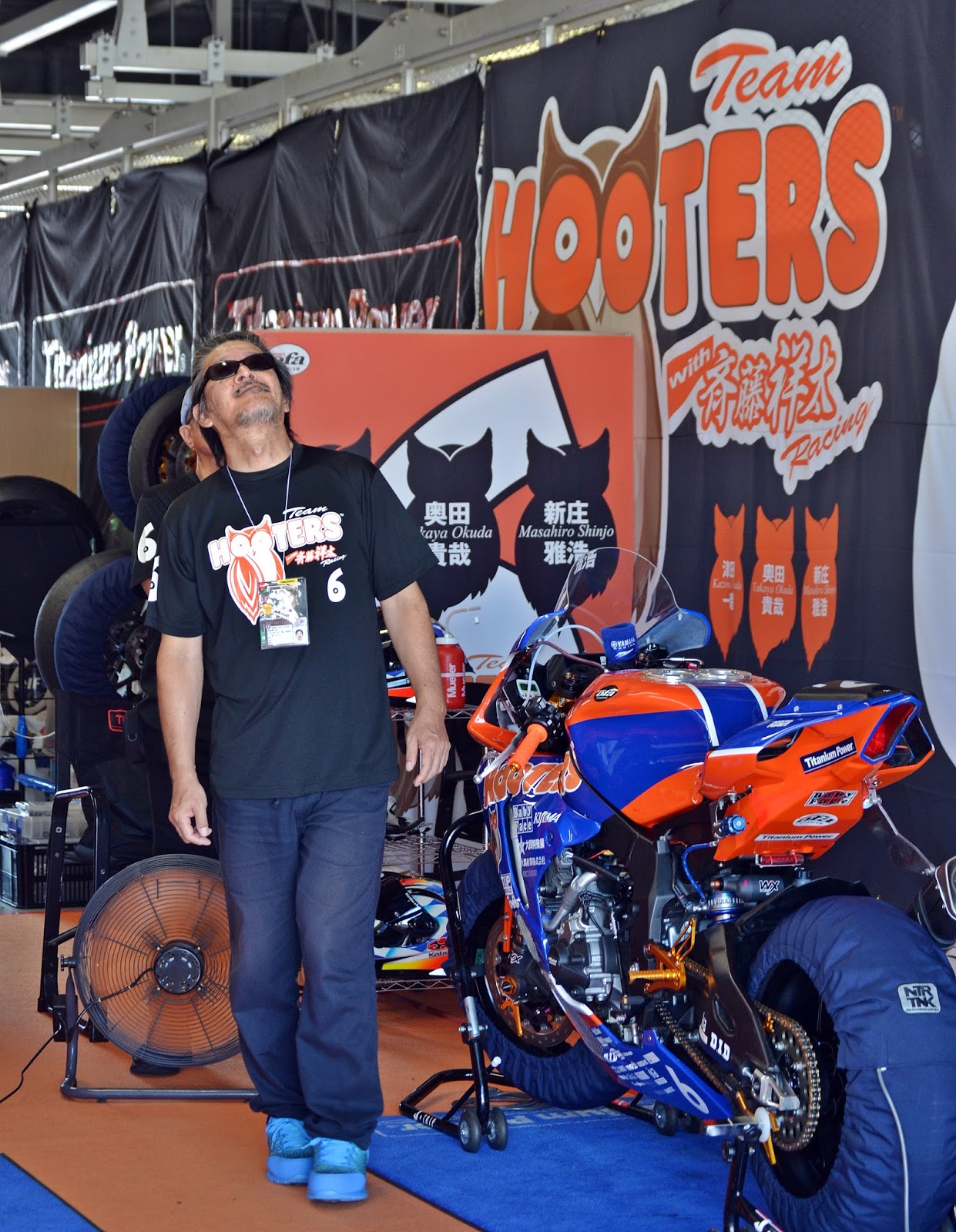
| Apparently there is a rule that at every motor race, anywhere in the world, someone must run Hooters livery. Masahiro Shinjo on the Team Hooters Yamaha YZF-R1. |
| Flower Power - The Sakura Project Kawasaki ZX-10R with Hidemichi Takahashi aboard. |
| Flower Power programmer. Awesome hair. |
| Takumi Takahashi on the MuSASHi RT HARC-PRO Honda CBR1000RR. |
Monday, September 12, 2016
Images from the 39th Suzuka 8 Hours, Part Three
Images from the 39th Suzuka 8 Hours. For the full story of the race and more images, purchase the book at:
http://thebp.site/87100
Thursday, September 8, 2016
The Edge Of Madness, And Why Living There Is Important ...
The Can-Am sports car race at Road Atlanta in July 1971 was not a good race for Formula One World Champion Jackie Stewart. The Can-Am series paid good money, more than F1, so Stewart flew across the ocean regularly to hustle a fat Lola sports car around North American circuits.
A flat tire and a struggle to re-start the car after the pit stop dropped him to 21st, three laps down. Stewart went back out. The brakes started to fade and the right front wheel wore a big hole in the top of the fender, showering him with tire and bodywork debris. He came back into the pits, went back out and set the race's fastest lap time - 1.3 seconds better than he'd done in qualifying and 0.3 seconds quicker than pole. The car finally broke for good. When asked why he was driving so hard when there was absolutely no hope of a win, a podium or even points, Stewart said:
"Ooch! Ye must never let y'self fall into the habit o' drivin' at anythin' less than yer maximum!"
The saying is that consistency wins championships. Like many other things in life, that saying is partly true. It obscures a deeper truth. What really wins championships is speed. At the end of the day, to seize a championship requires the racer to finish higher up the order than the other riders, race after race. Slower riders do not win races. They are gifted wins when faster riders falter. Occasionally it happens often enough in a short enough period of time that a championship goes to a slower rider. That is one of the joys of watching motorsport.
But more often than not, speed gives you a better chance of finishing higher. Speed keeps you out of trouble, prevents you from fighting with mid-packers as you try to get to the front after starting from the third row. Speed puts you ahead of your competitors on the track. All other things being equal, the faster rider/bike combination wins the race more often. And even though all other things never are equal, pure speed gives you more of a chance to take the win rather than inherit the win. As a competitor, you don't prepare to inherit wins. You prepare to beat the others. Yes, most of us would rather be lucky than good. But you can't control luck. You can control speed.
Talent makes you fast. Experience keeps you fast. There's a reason that riders are slower when they come back from the off-season for the first tests of the new year. They're not less talented. They're further from the last time they experienced riding on the edge. They're not as used to the sensation of losing the front tire under braking, for example. In the first practice session, it seems to happen in a millisecond.
By mid-season, when the rider has saved the front-end washout dozens of times, the experience is familiar. The feedback from the bike telling you that it is about to happen is recognizable. Time stretches, and the transition from full grip to slide seems to take longer. The panic reaction is gone. There's more brain power to decode the messages from the tire, suspension and bike, and the messages are clearer because the rider has heard and felt them before.
To be on top, a rider has to be the best at interpreting those messages, and understanding the new ones that come from changes to tires, suspension, engine, brakes and chassis. And the ability to understand the language of those messages is developed and maintained like any other ability - through practice and experience.
It has been mostly a pleasure to watch Marc Marquez dance off with the MotoGP championship lead in 2016. He's won when he could, finished on the podium when he couldn't, and taken what points were on offer when the podium was out of reach. His new-found maturity has met with widespread praise.
But looking at Stewart's comment, there's a reason for a bit of concern to creep in. Backing off even slightly means less time spent on the edge. It means less time with the bike speaking the language of imminent loss of traction, the fine line between slip and grip as the power pours through the rear wheel.
It is admirable to pace your way to a championship. But a racer does so at the risk of forgetting how to live on the edge. And the less the racer lives in that environment, the fewer experiences on the edge the racer has, the more unfamiliar territory it is and the harder it is to survive there. A lap of 1:27 is flying for a lightweight bike at the big track at Willow Springs. I once heard a rider say, "It's been a while since I've run a 1:27 here." To the best of my knowledge, that rider never did again. I've heard racers say, "At the height of my powers ..." What that phrase means is that they've lost the direction to the edge, and even if they got there, they wouldn't be able to understand the language spoken there.
That is why it is important to reflect on Marquez' race at Silverstone 2016 before it disappears into the mists of history. The setup on his Honda was poor, and the bike has been a handful all year. On top of that, Marquez chose the wrong front tire. The machine was a disaster from the moment the lights went out. The smart thing to do would have been to cruise around and gather points.
Marquez took a different approach.
The two-time MotoGP champion saved countless front-end slides on his elbow. He battled frantically with Valentino Rossi and Cal Crutchlow and Andrea Iannone, ran off the track, came back onto the track, forced his way past Rossi again and then nicked Crutchlow at nearly 200 miles an hour, sending himself off the track once more before re-joining the race and passing his teammate on the last lap for fourth.
It was absolute madness. It was every corner on the edge of disaster. It was exactly what a rider with a 53-point lead in the championship chase should not be doing.
But Marquez and Stewart know that there are worse things in racing than crashing, losing a race or even a championship. At all costs, the racer must maintain a residence on the edge of madness and make it home. And it was glorious to watch Marquez re-stake his claim to that place where mere mortals - including some World Champions - never can go.
Subscribe to:
Posts (Atom)