MOTORCYCLE

Tuesday, November 8, 2016

Images From The WERA West Season Finale, Part One

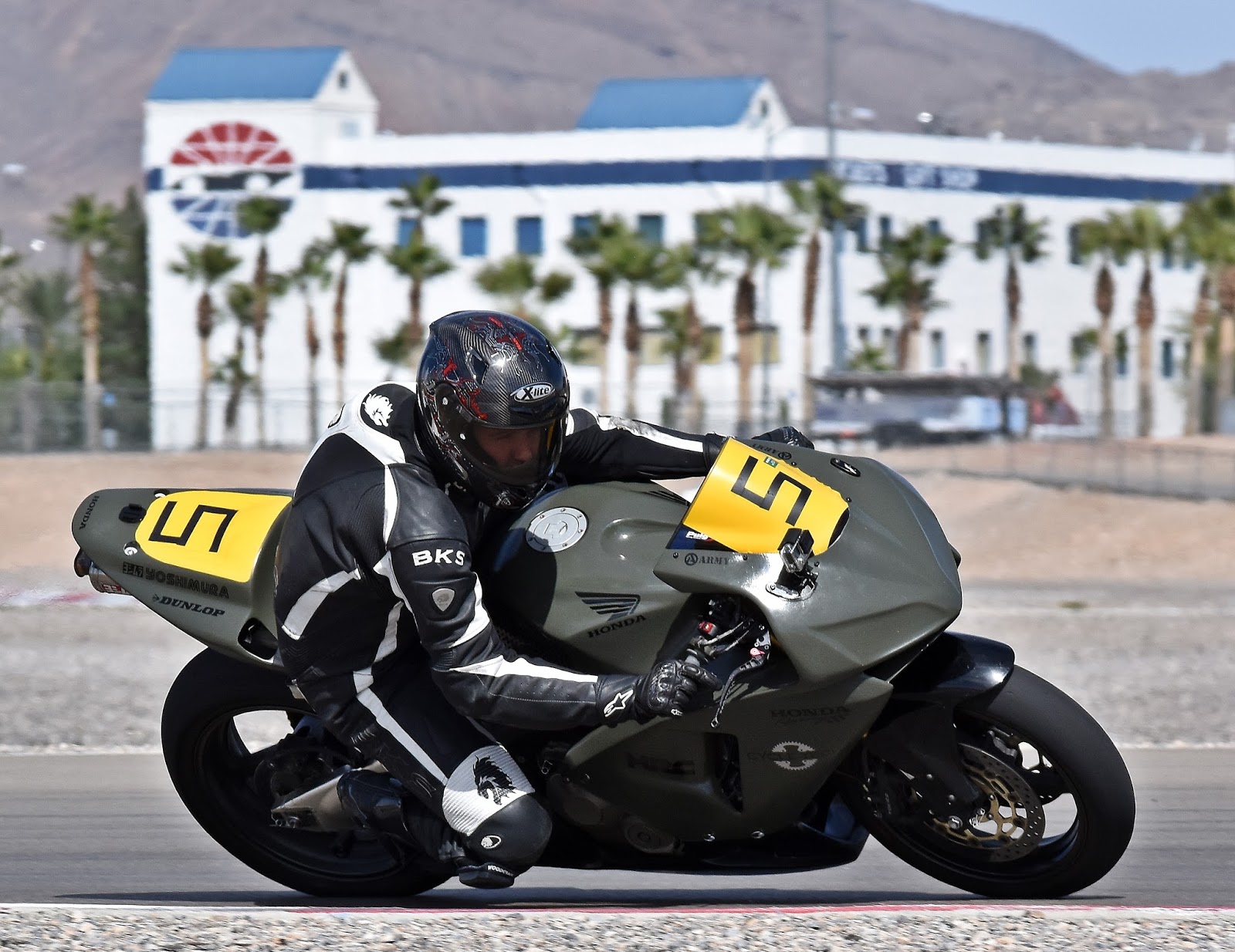
Images From The WERA West season finale at Las Vegas Motor Speedway. Release of the 2016 WERA West Yearbook should be this week. Stay tuned ...

Sidecars from SRA-West raced both days in their own penultimate round of 2016.


Brad Saenz set out to win a championship on his Triumph 675, and sealed the B Superbike title.

Matt Warnert showed up for his first race weekend on a nearly-vintage Honda CBR600RR, struggled on Saturday and came back to take trophies in both of his races on Sunday.
The lightweight battles were awesome, as always. Erick Vizcaino (63) leads Jack Baker (27) through the final turn, with Toby Khamsouk behind.
Curtis Biegel (848) and Steve Zoumaras.
Start of one of the mediumweight races, with Mookie Wilkerson (136) leading Anas Sorhmat (117), David Guerrero (20, yellow plate), Edgar Zaragoza (20) and Vincent Mendez (hidden). On a clear day, the mountains surrounding the track always take my breath away.
 
Posted by sandi at 7:49 AM No comments:
Email ThisBlogThis!Share to XShare to FacebookShare to Pinterest

Tuesday, November 1, 2016

Second Thoughts


The problem with signing riders before the season is over is that the new team has half a year or more to worry about whether it made the right choice. Signing a rider is always a stab in the dark, a bet on the future, and having time to wonder about whether you've made the right choice isn't always a good thing.


Last weekend's International-level races likely have allowed a few teams to sleep more comfortably, more confident that they have made the right choices. A few have got to be worried about their decisions. And one or two have got to be waking up in a cold sweat at 3 a.m., calling their lawyers to see exactly how iron-clad those contracts with the new riders actually are ...

Among those sleeping well likely are the Ten Kate squad that runs the Honda World Superbike Team. Nicky Hayden managed to squeeze one more front-row qualifying slot out of the aging CBR1000RR platform before it gets put out to pasture. Hayden is the only rider other than Chaz Davies on the factory Ducati and the two factory Kawaski riders to win in World Superbike this season, and he's made his teammate, the highly-acclaimed Michael van der Mark, look slow and inconsistent. 

Hayden will be back for another season, alongside Stefan Bradl, a Moto2 World Champion and a guy who is overlooked mostly because he had the misfortune of competing against one Marc Marquez. With an all-new bike on the way and these two riders in their stable, Ten Kate has got to be comfortable looking forward to 2017. Taking the fight to the Ducati and Kawasaki teams is going to be hard, but it's difficult to think of two better riders that Ten Kate could have signed to head the charge.

Ducati's got to be thinking it made all the right choices. On the MotoGP side, signing Jorge Lorenzo was a no-brainer, and he's going to be motivated to make Yamaha look bad. Andrea Dovisioso's win in Sepang last weekend validates the company's choice to keep an experienced hand, skilled in tricky conditions, on board. On the World Superbike side, Chaz Davies and the Panigale look unstoppable. That means that week-in, week-out, Ducati will have a shot at the wins, whichever Marco Melandri - the crazy-fast or the just-crazy - shows up for work on Friday morning for Free Practice 1.

Suzuki's GP squad has got to be a bit worried. Andrea Iannone keeps falling off the bike, as he did again last weekend. (An aside: I am glad that Iannone won in Austria, because I honestly think it will be his only MotoGP win, and I wish that every rider who has the courage to grid up for a MotoGP race could experience winning at least once. Call me a hopeless romantic.) Alex Rins' performances in Moto2 have not been anything to write about of late. Yes, he's been injured. But playing hurt is part of this game. Suzuki has got to be wondering which Rins is going to show up in 2017; the one from the first half of 2016 or the second half.

Yamaha, interestingly, is the factory that has got to be losing the most sleep and spending the most time pouring over escape clauses in rider contracts. Valentino Rossi is still fast, but is making more mistakes than ever before to ride at that pace, and he seems to be struggling to find the magic he could pull out of a hat a decade ago. It's hard to see Rossi losing a race like Sepang if you wound the clock back a decade. And Maverick Vinales is fast but inconsistent, and Yamaha has to wonder if it's the Suzuki that Maverick rides or ... Maverick.

Yamaha's World Superbike team has to be even more worried than its MotoGP team. Alex Lowes has defined under-performing this season. When teammate Sylvain Guintoli has been fit, he has been Lowes' equal at worst and thoroughly thrashed him at best. After Guintoli came back from missing half a season due to injury, matched his teammate straight away and put the YZF-R1 on the box in Qatar last weekend, Yamaha had got to be wondering if keeping Lowes and letting Guintoli go was the right call. And who is taking Guintoli's seat next season? van der Mark, whose picture is next to Lowes' mugshot in the dictionary next to "under-performing."

By the time Phillip Island rolls around, every one of these observations may be proven to be incorrect. But that's a long way away, a lot of rest for some teams, and a lot of sleepless nights filled with cold sweats for others.
Posted by sandi at 10:15 AM No comments:
Email ThisBlogThis!Share to XShare to FacebookShare to Pinterest

Wednesday, October 26, 2016

Straight Gangsta ...


Wrapping up the MotoGP title early allows for a viewing of the season from some distance, from a different perspective, a chance to see some of the other realities that the 2016 campaign has brought into focus. The season has been more than just a showcase for the otherworldly talents of Marc Marquez. For those willing to look a little deeper, it showcases some other truths about racing in general, the industry of Grand Prix racing, and where Grand Prix racing fits into the broader picture of those who pay for it. It shows that HRC may just be straight racer gangsta, and that's meant to be a compliment. The object of the day, after all, isn't entertainment or fair competition. It's beating the others and demonstrating, beyond doubt, that you are best.

Consider:

- The spec electronics package hasn't done a thing to make the racing better. Not a thing. Many of the races have been runaways, with virtually no lead changes past the halfway point. Take away the unpredictable weather of 2016, injuries and the frightening tire lottery that Michelin has hurled at the competitors, and you see the same or even bigger gaps at the front of the field. 

Interestingly, an argument could be made that the spec electronics have made things worse, because teams and factories no longer have the wide array of capabilities of last year's electronics to refine their bikes to the edge of their performance abilities. You could argue that the spec electronics have given satellite teams a better shot at the wins. But that ignores the fact that it has been one factory that has made the best use of the rules package this year, and the success of only that manufacturer's satellite teams has been at the expense of the other factory squads. 

In Australia, on a satellite Honda, Cal Crutchlow straight-up, flat-out beat the best that the Yamaha, Suzuki and Ducati factory teams could throw at him. Only those ignorant of how racing works ever believed that spec electronics would "level the playing field" or "make things more competitive" at the front.

- HRC didn't even bother starting to sort out its electronics by the start of the season. It was clear, when Marquez and Dani Pedrosa were complaining about a lack of acceleration, that horsepower wasn't the problem - it's never the problem on a modern MotoGP bike. It's getting the power to the ground. Last year's RC213V had a honed-to-perfection set of electronic rider aids that tamed the wheelies. This year's crappier electronics package wasn't sorted at the beginning of the season, so the bike wheelied and the riders couldn't get on the gas like the Ducati and Yamaha riders could.

HRC's attitude seemed to be, we'll fix it when we get around to it. 

And that attitude is kind of understandable. 

There was no consensus as to when the wings would be banned - not if they would, but when. No sense in developing an electronics suite that worked only with an aero package that would be thrown in the dumpster in a month. 

There were the unpredictable Michelin tires to sort out.

And you have to remember that a race team isn't a stand-alone entity. It's part of a huge corporation, fighting for money with all of the other parts of that huge corporation. And it's hard for a race team to make a plea for funding and resources to make the crappy spec electronics do "X" when someone else in the board room says, "Hey, didn't we give you money to do 'X' with the package you had last year? Where did that money go? And don't we have a bike in the production lineup that already does 'X'?" It's embarrassing for the race team to explain that the MotoGP rules now ban the company's upcoming CBR1000RR's electronics package that will cost - literally - a mere few hundred dollars per unit.

So, in straight gangsta fashion, HRC sat and waited, completely confident that it would get everything sorted out in time to take the championship. Sometimes, the boldest move is to stand still and wait for the exact moment to attack. And the definition of gangsta is knowing that when you do move, you will crush the competition.

It took Honda and HRC until the post-Brno test to get around to sorting out the electronics package, according to Marquez. By then, the wings were heading for the recycle bin, so Honda stuck a pair of big ones on the front of the bike and called it a day on wing research. Marquez was starting to understand the Michelins. And it was clearer and clearer what the engineers needed to do with the spec electronics.

Honda now has won seven of the nine last rounds on a bike that the "experts" criticized as an ill-handling slug at the beginning of the year. With no mid-season changes to the engine spec allowed, the thing is now virtually a match in a straight line for the fastest bikes in the field, the Ducatis. And it handles well enough that not only the factory riders, but the satellite riders, can get the thing going well.

Sometimes gangsta is sitting on the sidelines, knowing that when the time is right, you can stride in and let everyone else on the grid know exactly who the 800-pound gorilla is.


Posted by sandi at 9:22 PM No comments:
Email ThisBlogThis!Share to XShare to FacebookShare to Pinterest

Wednesday, October 19, 2016

The Kenan Principle

  
Laurence J. Peter noted that employees tend to be promoted to their level of incompetence and stay there. No higher-up wants to admit they made a mistake and demote someone they promoted. So over time, the principle suggests, in any given hierarchy, most positions get filled by incompetents.

Racing works this way, too. Teams, mechanics, engineers and particularly riders get noticed by winning in the lower ranks and then move into more and more challenging environments. It is easiest to see in rider careers; when the rider stops winning, there are no more promotions. Riders must exhibit not just competence, but excellence, by dominating in the lower divisions before they get the call-up for a front-line shot at the big leagues.


Jorge Lorenzo crushed the 250cc GP field in 2006 and 2007, winning 17 races in two years and taking the title easily both years; Yamaha had his name on a contract to ride its factory MotoGP bike before his second year was even well and truly started. Valentino Rossi won 11 125cc GP races in 1997, and that got him a 250cc GP ride. He won nine 250cc GP races in 1999, and that got him a factory 500cc Honda ride - and the wrenching skills of Jerry Burgess to help out. 

It's interesting to look at Casey Stoner's career, because he didn't dominate the lower classes in the same way, and he wasn't invited to ride the front-line weaponry. Stoner kicked his way into racing immortality through the back door, taking the less-fancied Ducati MotoGP ride and riding that evil, scorching missile straight to his first World Championship.

What Marc Marquez did to the lower classes doesn't even need to be mentioned, to avoid embarrassing his competitors - and you have to use the loosest definition of competitor in that context.

Those four riders account for 15 of the last 16 500cc/MotoGP World Champions. The only interloper was one Nicky Hayden, who got his ride in MotoGP by, frankly, making the rest of the AMA Superbike paddock look slow.

So what of the rest? What are they to do? Especially those who show that they have the talent, the skills and the bravery, to ride at the very front in the lower ranks?

Ego and finances sometimes dictate that a racer chooses to ride mid-pack in a higher division rather than to race for the wins in the lower classes. Personal sponsors pay more for exposure in the higher ranks, and it can be easier to get those sponsors to begin with. And sometimes that will pay more than a salary in a lower division, even the salary of a race- and title-winner. So you'll see riders sign on with satellite teams in, say, World Superbike, rather than race for wins in World Supersport.

Kenan Sofuoglu seems to be one of those racers who had the choice. His career is fascinating. In his rookie World Supersport season in 2006, he won two races, then crushed the competition in 2007 for his first World Championship. The next year, he moved up to World Superbike on a satellite-equivalent team (he was on the third Ten Kate bike on what the squad called a junior team) and wasn't successful. He moved back down to his level of competence, struggled the next season, then came back in 2010 and won his second World Championship.

For 2011, he moved to Moto2. One podium in 14 starts was not the level of success he sought. The next year, he moved back to World Supersport, his level of competence, this time with Kawasaki, and won his third World Championship.

The next season was pivotal. Sofuoglu had the choice to move back to Superbike with a team that does not have full factory support. Had Sofuoglu gone, he would have been in the same place that he had been in 2008. Sofuoglu chose instead to stay in World Supersport. He's since gotten two more World titles. He now has more Supersport World Championships than any other racer. 

He is revered as a sports figure in his home country of Turkey; when his ailing son was dying, the president of the country publicly announced that all of the country's resources would be at the disposal of Sofuoglu's family so Kenan could go race. And Sofuoglu mentors and manages young Turkish riders, one of whom, Toprak Razgatlioglu, won the 2015 European Superstock 600 Championship.

It's easy to say from the sidelines that every racer should always race in the highest possible class. But by functioning at his level of competence, Sofuoglu has not only made himself a legend, but has increased the visibility of the sport and given younger riders chances they might not have otherwise had.

Practicing the Kenan Principle, in other words, has worked out not just for Sofuoglu, but for the sport. Not a bad principle by which to live.


Posted by sandi at 8:43 AM No comments:
Email ThisBlogThis!Share to XShare to FacebookShare to Pinterest

Tuesday, October 11, 2016

Getting Stuck In ...

 
... is a British informal phrase, defined as to "start doing (something) enthusiastically or with determination." In the world of motorcycle road racing, it is most often heard during the broadcasts of British Superbike series racing, when one of the riders with a reputation for more bollocks than brains arrives on the scene of a scrap for position and an announcer booms out, "Oh yeah! 'eel get stuck in, 'ee will!"

Endurance racing requires a different type of "getting stuck in." It requires brains and controlled aggression. It takes a rider who is blindingly quick and equally smart, someone who knows exactly when to dive to the inside of another rider for an apex and who knows when to hold off. Raw speed remains critical, but discretion usually is the better part of valor in an eight-hour or longer contest. Actually, it's usually the smart move in a race as short as a GP or a Superbike World Championship sprint race.

But sometimes, sometimes ... 

 
Let's just say that there is such a thing as being too smart. Motorcycle racers do things that seemingly defy the laws of physics. And when you try to do something that you're not sure if it's going to work, if you open the throttle 10 yards earlier than you thought was possible or brake 10 yards later, the resulting euphoria can be addicting. Abandoning caution - and making it work - can take your breath away. Racers live for moments like those.

Anthony Delhalle is one of the best in the business when it comes to balancing speed and aggression. He's a multi-time World Champion in the discipline of motorcycle endurance road racing. His speed is undeniable, his mistakes rare, and the combination of the two makes him one of the most-respected figures in his field and a pillar of the Suzuki Endurance Racing Team rider squad.

Into Delhalle's orbit entered one Juan Eric Gomez, also a World Endurance co-champion for SERT and a manager for Racing Team JEG, which races in the FIM CEV Repsol European Championship. It's a private but professional operation based in Spain that helps give up-and-coming riders and mechanics in the sport experience in the field of motorcycle road racing. 

Gomez kept offering Delhalle a spot on the Superbike he fielded. Delhalle always had a good reason to turn the offer down - he was a contracted Suzuki rider at the time JEG campaigned a competing brand. There were conflicting race dates between the FIM EWC and the Repsol CEV championship.

But this year, Gomez went out and got a Suzuki. And Delhalle had no reason to say no anymore. Dominique Meliand, SERT manager, wasn't thrilled with the plan, but didn't say no. "Obviously, I do not think he jumped to the ceiling saying "whouaaa, it's great," Delhalle told Moto Revue.

So Delhalle went sprint racing. He offers very logical reasons. It's good training, something he can't get with SERT, which can't afford to go testing whenever its riders want to go riding. A front-line EWC bike is an expensive, sophisticated piece of kit. And in the Repsol series, Delhalle rides a different brand of tires and can learn something, and he can push his personal limits as well.

The point of all of this is that if you haven't seen it yet, go to Youtube and watch the Repsol CEV Superbike races from Jerez this season. The highlight, beyond any question, is watching Delhalle getting stuck in, good 'un proper.

The first indication that Delhalle is dropping "controlled" from "controlled aggression" comes about two-thirds of the way through the first race of the double-header. Aboard the Racing Team JEG Suzuki GSX-R1000, Delhalle is drafting the Leopard Yamaha Stratos YZF-R1 of Alejandro Medina down the front straight. At the end of the straight, the GSX-R1000 veers toward the apex at a rate of speed that, from half a world away, you can see isn't going to work. Delhalle makes the pass (undoubtedly Medina heard Delhalle yelling "Yee-haw!" as the Suzuki went past) then runs wide, the front slides, the rear slides, and Delhalle is closer to the outside edge of the track than the apex when he finally turns the big Suzuki.

Notice served.

The next laps continue in this vein. Delhalle gets past Medina and promptly spins up the rear tire on a corner exit, launching himself out of the saddle. Every turn is a spectacular near-disaster. Marc Marquez would have covered his eyes watching this. And the climax comes in the run to the flag, where Delhalle and Medina throw elbows and swap paint. If Delhalle did this in an endurance race, Dominique likely would run out onto the track, grab Delhalle off the bike as it went past, and French-slap him all the way down Pit Lane. But it was a sprint race, and it was all (barely) within control and within the limits of acceptable risk-taking in a sprint contest.

Delhalle put it on the box, taking third spot. He learned something, certainly. He sharpened his skills, got familiar with new tires, trained in a competitive environment, etc., etc. All good. All legit.

But best of all, 'ee got stuck in, good 'un proper.
Posted by sandi at 9:13 PM No comments:
Email ThisBlogThis!Share to XShare to FacebookShare to Pinterest

Friday, September 30, 2016

Early Days ...


The first race of the season offers something that will not happen again for the rest of the calendar - the completely unexpected. New teams join experienced crews in the paddock. New riders throw their legs over bikes they've never ridden in anger. And experienced racers find themselves challenged by a new discipline, new tires, new tracks, new everything. And any venture into unknown territory is fraught with the potential for mistakes.

The 80th running of the Bol d'Or endurance classic, the 24-hour contest held at Circuit Paul Ricard that opened the 2016/17 EWC season, featured all of the above. The challenge of a 24-hour exposes every weakness, but equally puts every strength on full display. So exhausted that all they want to do is collapse, somehow the victors seem to put that aside for a few shining moments on the podium, where they celebrate not just their accomplishments, but the pitfalls they have escaped.


Two racers added FIM Endurance World Championship competition to their racing resumes in France. In each case, they were faced with a challenge that offered a lot of opportunities for things to go wrong. And in each case, more or less, the endurance series offered them the chance to remain professional motorcycle racers - perhaps the only opportunity they had.

MotoGP and World Superbike racer Randy de Puniet turned his first laps in FIM Endurance World Championship competition on the SRC Kawasaki ZX-10R. A podium finisher in MotoGP and a winner in 250cc GP competition, de Puniet took a year off from competition in 2014, taking a paid job developing the Suzuki MotoGP machine. He was rewarded with a Superbike World Championship ride with Suzuki in 2015. 

It was scant reward. The Crescent Suzuki team had one foot out the door of the series and put little effort, relatively speaking, into making the GSX-R1000 competitive. And de Puniet was blunt in his criticism of the team - his interviews on the series' website pulled no punches:

http://www.worldsbk.com/en/news/2015/De+Puniet+Not+an+easy+situation+to+go+through

After a year with only two top-10 finishes, de Puniet found that he was not exactly hot property on the rider market. The French rider found a seat with the French SRC team, which had been struggling since winning the Bol the year before. For de Puniet and his team, the race offered a promise of a fresh start, one with the potential of great success and significant failure.

Moto Ain put Moto3 winner Alexis Masbou on its Superstock Yamaha YZF-R1. Masbou didn't just leave Moto3, he was being pushed. After scoring a Moto3 win in 2014 and another in 2015, Masbou was only able to find a ride on a team fielding a Peugeot Moto3 machine for 2016. That worked out about as well as it sounds like it would, and Masbou was dropped from the team halfway through the season. And it was his last year in Moto3, as the class age limit will prevent him from racing in the smallest GP class in 2017. Masbou was in free fall, and the Moto Ain team offered him a branch to grasp.

Both made the absolute best of their opportunities.

The SRC team suffered a broken front axle in the middle of the night, but de Puniet, Gregory Leblanc and Fabien Foret kept pushing and as things went wrong for the others, kept moving up the order. In the end, SRC had moved almost as far up the order as was possible, ending the round-the-clock contest second overall. The last time de Puniet stood on a podium in international competition was in 2009. Seven years is an eternity in a racer's career, and those on the outside can only guess at the emotions de Puniet felt on the podium. Gilles Stafler, SRC team manager, said, “I’m delighted with Randy’s work. He’s a genuine rider. He just got better and better ..."

Moto Ain went one better. On its Superstock-spec R1, the team took sixth overall and first in class. And Masbou, who hadn't even cracked the top 15 in Moto3 this season and hadn't scored a point, who was out of a job and was barred from looking for work in the class where he was most successful, was suddenly and spectacularly once again an international motorcycle road racing winner.

While endurance racing offers the unexpected, sometimes the entirely predictable can still be a surprise of sorts. Suzuki Endurance Racing Team debuted no new machinery, no new riders, no GP stars. Its GSX-R1000 was one of the oldest machines in the field, overshadowed by the more modern Yamahas and Kawasakis on the grid. 

Yet SERT, which last season won its 15th endurance championship, fields a machine, a team and riders that have been tempered in the furnace of endurance racing success. And as others fell and fell into difficulties, SERT pounded its advantage home. SERT led at the eight-hour mark and picked up the bonus points for leading. SERT led at the 16-hour mark and doubled up on bonus points. And SERT was nine laps ahead when the flag dropped after 23:51.03.405 of racing, making it a nearly perfect weekend for the veteran squad. SERT led 683 of the 687 laps. That is not a misprint. That is nearly a flag-to-flag win in a 24-hour race. In celebration, Suzuki France ran an ad proclaiming, "The Cougar Spanked The Youngsters!" Never bet against old age and treachery ...
Posted by sandi at 10:06 PM No comments:
Email ThisBlogThis!Share to XShare to FacebookShare to Pinterest

Thursday, September 22, 2016

Something Goes Wrong Again ...


Racing at the front looks hard enough from the outside. That's because it is hard. But sometimes the real struggle takes place at the back of the pack, away from the cameras and reporters, and is so utterly insane that it sounds impossible. Sometimes the rider is the victim. Sometimes the rider is the cause. Sometimes the stars line up in such a way that well-intentioned people make hideous mistakes. And sometimes hideous decisions are made by people who - for perfectly reasonable-sounding reasons - aren't particularly concerned about the well-being of the rider on the firing line.
 
Three recent stories:


- Josh Brookes' talents are undeniable. He's the 2015 British Superbike Champion and a podium-finisher at Suzuka in the 8 Hours. The SMR team, which took Brookes to the BSB title, also is a proven winner. And yet this season, when the team stepped up to the Superbike World Championship, is a disaster. Brookes has only three top-nine finishes aboard the team's BMW S1000RR and is languishing 15th in the standings; teammate Karel Abraham, a MotoGP veteran, has done worse.

Brookes told me at Suzuka that, to put it simply, the team can't get all of the bike to work at the same time. The team loads software that doesn't work with the other software on the bike. Imagine having to get on a machine that the team doesn't understand. And Brookes really opened up in an interview with an Australian website, revealing that he really doesn't have a "team" in the traditional sense of the word. SMR runs the chassis; BMW the engine and electronics, and each camp says what it is doing is fine and the other side needs to change, long arguments ensue, and the bike never improves. It's amazing the bike actually starts. 

It's hard to imagine something worse. But if you read the interview, Brookes talks about his crew chief being prohibited from calling him in for a tire change in the drying conditions at Assen. Brookes had a shot at the win, but was forced to stay out longer than the other riders because he was temporarily in the lead after other riders had pitted. "The management says they ‘need the television time and leave him out there,'" Brookes says his crew chief told him after the race. When Brookes finally came in, the rear tire that went onto his bike had been unplugged for too long and was cold and he crashed on the next lap. What goes through a rider's head when she or he hears that? How do you even show up for work the next race? And yet, you do, because if you walk away from that situation, you run the very real risk of walking away from your career.

- Sometimes the rider senses the oncoming decline in fortunes, and desperate to reverse it, makes it worse. It is a spiral, tightening like a noose, a python that slowly and painfully crushes a promising career. Karel Hanika won the 2013 Red Bull MotoGP Rookies Cup championship, winning half the races that season. He moved up to Moto3 with a front-line team and struggled initially. Then he struggled some more. In two years of Moto3 competition his best finish was a seventh. Dropped by the Ajo Motorsports team, he joined Mahindra for the 2016 season. Seven races in, he was pointless, and the team decided that continuing with him was as well. Hanika found a ride in the Repsol CEV European Championship in the Moto3 class. At the last round, in Aragon, he demonstrated why his former crew members had nicknamed him "Gravel" Hanika. In an overataking move that reeked of desperation, Hanika flung himself into a corner and crashed, taking out two other riders. In 2014, Hanika had a VIP ticket into the GP world. It's hard to see him finding the entrance again.

- Louis Rossi, fired from the GMT94 Yamaha squad in the Endurance World Championship after crashing three times in his first race, landed another ride for the 2016/17 season. It wasn't nearly as competitive or as lucrative, but at least he was in the game on the Tecmas Racing Team's BMW S1000RR. But he never made it to the starting lights. Incredibly, at the season-opening Bol D'or, in his first appearance for Tecmas, Rossi crashed the BMW on the warmup lap, putting himself out of the race with a concussion and delaying the start of the event.

Winning is hard. Truth. But look down the field and there is a deeper truth to be found. Racing is hard. And sometimes there's no reward at all.

http://www.cycleonline.com.au/2016/09/06/catching-josh-brookes/ 

Posted by sandi at 8:41 PM No comments:
Email ThisBlogThis!Share to XShare to FacebookShare to Pinterest
Newer Posts Older Posts Home
Subscribe to: Posts (Atom)

About Me

sandi
View my complete profile

Blog Archive

  • ▼  2018 (2)
    • ▼  April (1)
      • The "Joy" Of Being Right ...
    • ►  February (1)
  • ►  2017 (44)
    • ►  October (1)
    • ►  September (3)
    • ►  August (5)
    • ►  July (2)
    • ►  June (7)
    • ►  May (10)
    • ►  April (6)
    • ►  March (2)
    • ►  February (6)
    • ►  January (2)
  • ►  2016 (48)
    • ►  December (4)
    • ►  November (5)
    • ►  October (3)
    • ►  September (9)
    • ►  August (4)
    • ►  July (1)
    • ►  June (3)
    • ►  May (2)
    • ►  April (2)
    • ►  March (5)
    • ►  February (3)
    • ►  January (7)
  • ►  2015 (56)
    • ►  December (5)
    • ►  November (2)
    • ►  October (2)
    • ►  July (1)
    • ►  June (20)
    • ►  May (26)
Simple theme. Powered by Blogger.