Thursday, February 2, 2017

It'll Be Just Like Starting Over ...

World Champion Stefan Bradl on a cooler racebike than most of us ever will ride, yet something that is barely a starting point for a front-line Superbike World Championship contender.


Part of the mythology of Superbike racing is that the machines are related to the motorcycles available at the local dealership. It is an attractive mythology for many reasons.

It makes the racing seem accessible to the fans in a way that GP racing cannot. A Superbike, it seems, shouldn't be impossible for someone to build in their garage, or at least at the local race shop. Obviously, there will be a few unobtanium bits, but the fundamental chassis, engine and suspension are comprehensible and recognizable.

And for marketing purposes, it is desirable for the fans to believe that the performance of the machine on the track reflects the performance of the machine they can purchase and ride.

A nice belief system, indeed. And yet, sometimes you get a glimpse into the reality of Superbike racing and you realize how much of that mythology really is exactly that.

Recently, I had the opportunity to ride on the track the 2016 Honda CBR1000RR and a 2016 Aprilia RSV4 RR, back-to-back. 

I took the Honda out first, because Hondas always seem to be friendly and comfortable mounts for track days as well as intensely practical street machines. And the CBR1000RR was exactly what I thought it would be: rangy and comfortable, a bit large but still flickable, stable and fast, if not the fastest-revving thing. Still, if I hadn't ridden anything else, I would have been thrilled at the CBR's performance, and if I am honest with myself, I still am. A wonderful sportbike.

But ...

The Aprilia made the Honda seem like a sport-touring machine. The Aprilia was tiny, insanely quick and responsive, torquey and revvy all at the same time. The bike felt like it was hard-wired into the pavement, riding in it, not over it. An entirely different level of performance from the Honda. If the CBR felt like a streetbike sharpened up for track duty, the Aprilia felt like a racebike tamed for street duty.

I got off the Aprilia and thought, how does anyone beat this thing on a Honda?

And yet, you look at the results of World Superbike in 2016, and that is exactly what happened. Aprilia had exactly one podium. BMW had zero. Yamaha had one, MV Agusta had zero. Honda, with its big, cushy, friendly CBR1000RR, had 10 podiums and a win, third-best of all the manufacturers. Granted, it was a long way to Ducati's second-place finish in the Manufacturers Championship and 23 podiums. But Honda was a long way clear of the manufacturers below it. 

And that wasn't the only time the Honda seemed to punch above its weight category. That big, friendly CBR1000RR ran up front at the Suzuka 8 Hours against some insanely advanced Yamaha YZF-R1s and new Kawasaki ZX-10Rs. Honda's riders in the British Superbike series took fourth and fifth in the Championship there, and Troy Herfoss won the Australian Superbike Championship.

Riding the stock Honda CBR1000RR provides a whole new respect for the development that teams like MuSASHi and Ten Kate have done on the racebikes. Every part has been looked at, every performance parameter refined, and it is awe-inspiring to consider how far those incredibly talented tuners took that stock machine and refined it into a race- and championship-winning machine. It may still say CBR on the gas tank. But that's not even where the gas tank is anymore. The MuSASHI, the F.C.C. TSR Honda, the Ten Kate Honda Superbikes are racebikes, and what those tuners have done with the stock machine is something to marvel at.

(btw, lest this read like a Honda love-fest, I would say the exact same things about the Yoshimura teams in the U.S. and in Japan who were racing a GSX-R1000 that was nearly as old as the CBR1000RR. Yoshimura did stunning things with the old platform, and deserves the same respect and admiration as the Honda tuning squads.)

It will take a while for even those talented tuners to bring the replacements for those teams to competitiveness. Both Honda and Suzuki have brought new Superbikes to the table for 2017. Each are starting from scratch, more or less. Ten Kate showed up at the first winter tests with a bike that they had worked on for less than two weeks. There will be big gains at first. But the fine honing of the blade into a race-winning package is likely to take longer, half a season, maybe longer.

I can wait. I can, more than ever, truly appreciate the task that Honda and Suzuki have in front of them. And when they succeed, I will appreciate their accomplishments even more.

Monday, January 23, 2017

Images From The WERA West Season Finale, Part Two

Keir Leonhardt
 
With the WERA West 2017 season set to start this weekend, it's time to remind you to grab your copy of the 2016 WERA West yearbook. Click on the link below:

http://www.lulu.com/shop/http://www.lulu.com/shop/michael-gougis/the-2016-wera-west-yearbook/paperback/product-22952354.html

Also, the Moto West Grand Prix 2013-2016 photo book is available at ...

http://thebp.site/94691 

... and the 2016 Suzuka 8 Hours book is available at ...


And a look back at a few more images from 2016:


Luis Zaragoza
Jay Milhiser (76) chases Steve Zoumaras (678)
Fatih Buyuksonmez (36) leads Greg Arnold (271).
Even small crashes suck.
Vincent Mendez (948) leads Gilbert Silva (508).


Tuesday, January 17, 2017

All In ...


You could understand why Terry Rymer retired at 32 years of age from racing motorcycles professionally. By that point in his career, he'd won dozens of races, the British Superbike Championship, the Endurance World Championship (twice), the European Superbike Championship, races in the Superbike World Championship, the 24 hour races at Le Mans, Spa and the Bol d'Or.


Seventeen years on, he found himself wedged into the British Superbike paddock, manager of the JG Speedfit Kawasaki squad that fielded ex-Superbike World Championship star Leon Haslam and BSB star James Ellison. It's hard to imagine that Rymer wasn't getting his fill of racing.

But Rymer also was a consultant for a company that was expanding its motorcycle tire sales business in the south of England. And he had a very, very trick modern vintage Yamaha OW01 in the garage. And a racing series in the country known at Thundersport GB - roughly akin to the WERA or CCS/ASRA series in the U.S. - had a class known as the Dymag Golden Era Superbike class that the bike was legal for.

So last summer, after years of not racing, Rymer shrugged on a set of leathers and gridded up when Thundersport visited Donington Park.

The races can be seen on YouTube at the Thundersport channel. The greatest thing about them is to watch Rymer slowly get back into the racing groove. At first, he's hesitant. Then, as he sees the opportunity for a win arise, he starts pushing harder and harder. On the first televised race, he's clearly chosen the wrong tire, which gives up on him three laps from the end, yet he still manages to push it across the line first.

The post-race interview is spectacular. Rymer talks about losing the front and saving it on his knee, losing the rear, not even remembering where he made the first pass for the lead. He was riding hard, really hard for a 49-year-old, really, really hard for a 49-year-old with absolutely nothing to prove to anyone. The phrase "World Champion" is pretty much all the street cred anyone needs. Rymer's nailed that twice.

But it's a reminder that once the green flag drops, it's not about how old you are or what you did. It's about racing, and getting to the checkered flag first. And that talent that got you the title of "World Champion" is like a drug, sitting there on a shelf, and the presence of a track, a race and a bike is enough to make anyone do whatever it takes to get one more hit of that.

In a meaningless club race, Rymer, a man with nothing to prove, still went all in for the win. Makes you wonder if racing is somehow genetic ...

Tuesday, December 27, 2016

Wabi-sabi, Racebikes And No Reason


The movie "Rubber" begins with a monologue that centers on the concept of "no reason." Some things just are, for no reason that can be discerned. More important is to know when knowing the reason for something is completely unnecessary and detracts from the experience.

The Japanese wabi-sabi aesthetic's characteristics include "asymmetry, roughness, simplicity, economy, austerity, modesty, intimacy, and appreciation of the ingenuous integrity of natural objects and processes," according to Wikipedia.

I shot these images in the pits at a recent track day for vintage bikes and vintage riders. It is, I believe, a Honda CB160, gloriously unrestored and wearing its rust like a badge of honor. On any other track day, this bike would be ignored and unappreciated. On this day, between sessions, it was one of many machines that drew many appreciative visitors.

I am not Japanese. 

I have many other things I should be doing.

So why am I posting these images here?

No reason.

If you are still with me, you completely understand.


Saturday, December 24, 2016

A Ronin Goes Home For The Holidays

Racing is like life; it has a beginning, a middle and an end. While the ascent of a racer's career is magnificent to watch, the descent can be painful. The slow drop down the order, less-competitive rides, and all too often injuries as the rider tries to capture with pure desperation and force what once came easily, can be sad to watch. The racer mentality, the outlook that gets you to the front, blinds you to the inevitable.


And of all the sports, racing can be the most ruthless and unforgiving when it comes to retaining the athlete. For the team, or the factory, there is no place to carry an underperforming rider, as any given rider is, typically, either half or all of the entire athletic department. Results are all that matters. And you're only as good as your last race. There's little room for emotion, or even doing the right thing; it's a matter of economics and performance.

So there is something that is touching when a factory finds a soft landing spot for a rider who is on the downward arc, a place for the rider to serve the vicious master of ambition and drive that makes them grid up, anywhere, anytime.  
 
Ryuichi Kiyonari enrolled at nine years of age in the Suzuka Racing School junior program, the first student of that racing academy. Kiyo spent his early adolescence being trained as a road racing samurai for Honda. He graduated in 1995 at the age of 13. For 21 years now, he has raced. The racer's life is all that Kiyo has lived.

At the end of 2013, Honda called time on Kiyo's career, with the two not coming to terms on a new contract. At that point, had Kiyo retired, he would have been a success. He had won in World Superbike, won three British Superbike titles, and raced in MotoGP.

Instead, Kiyo left the Honda fold, shopped his services to BMW and Suzuki. He was a ronin, a warrior selling his services to the lord who needed him most. They were adequately successful partnerships; he is a popular figure in the BSB paddock and nearly took the title for BMW in 2014.

But it never felt right. Kiyo was raised by Honda, served Honda, and his BSB title-winning motorcycles were in Honda's collection at Motegi. It would have been somehow unsatisfying to see his career end with another manufacturer's logo on his leathers.

So for 2017, Honda and Kiyo are reunited. At the age of 34, it's likely Kiyo's last factory ride. He'll be racing in the All-Japan Road Race JSB1000 superbike class. And one gets the feeling that Honda made a space for him at the Superbike level, a way of thanking him for a career of representing the company well.

The ronin is home for the holidays.


Wednesday, December 14, 2016

Vision

Gratuitous Nicky Hayden shot.
If there was a need for any more proof that the Superbike World Championship needed an infusion of new thought and vision, that proof arrived with the recent announcement of the inverted Race Two grid. 

 
Straight from the Saturday Night Specials shootout at a backwoods U.S. dirt track, the idea of putting fast riders behind slow riders at the start and hoping something interesting happens reeks of desperation and a lack of vision from the series organizers.

It is the height of hubris for an Internet blogger to say to the owners of a multi-million-dollar international corporation, "Well, here's what you should be doing with your property." Warning: Such hubris is coming in about three paragraphs.

But, first a word of sympathy. Prior to Dorna's purchase of the Superbike series, it was a direct competitor to GP racing. So it was relatively easy to take certain steps to build and maintain popularity. If the other series was doing well, steal everything you could from them, then add what was missing. See prime-time broadcast television, United States, history of.

Now Dorna owns both. And robbing from one to feed the other is a zero-sum proposition. So it's not just a matter of one series emulating the other to steal audiences. Dorna now needs to figure out how to sustain World Superbikes in a manner that doesn't take away from the popularity of MotoGP, and prop up MotoGP while keeping Superbike healthy.

OK, here's the hubris part. What Dorna needs is vision.

First, a hard look at what World Superbike offers that MotoGP can't. From the outside, it appears to be two things - lower costs and showroom relatability. 

By racing production-based machines, the price of competing is reduced dramatically. You can, realistically, go racing for podiums, or at least top-six finishes, in Superbike for $100,000 per vehicle. You might - might - be able to do that in Moto2. Definitely not in MotoGP nor Moto3, where costs have escalated well beyond the initial intent of that class.

And by racing production-based machines, manufacturers can see a clear connection between what is raced on the track and what is sold to the public. This can leverage dealer, importer and distributor interest in the series.

Between the two, Superbike always will have a role. Companies will always want a showcase for their latest and greatest street machines. The lower cost of competing means that it doesn't take direct manufacturer involvement to put together a team to compete in the series. And if necessary, Dorna can prop up manufacturer involvement with subsidies, and get much more bang for the buck than in MotoGP.

The next step is to position World Superbikes as a placeholder. Trying to gather huge TV audiences is a mistake, a mistake that is understandable for Dorna to make because it is, essentially, a television production and promotion company. Superbike is the series you sell to the tracks that can't afford MotoGP, or when manufacturers want to race in a particular market. Do that, and you prevent another series - like, say, BSB - from coming in and staging races and stealing your audience. Sometimes, it's not about the profit you make, it's about the losses you avoid.

Short-sighted band-aids - inverted grids, naked bikes - work about as well as band-aids. They quickly fall off and stop doing any good. Dorna needs a long-term vision that understands that close racing is only part of the package. The AMA's old Harley 883 series had very close racing. It's dead. The Harley XR1200 series offered amazing-looking racing. It's dead.

Showcases for the latest and greatest streetbikes, rules that allow inexpensive modifications that bring bike performance closer, and a tight, packed weekend schedule that a racing fan can afford and understand are the things that bring in the audiences. Staying the course and building a solid platform with Superbikes in their proper place in the pantheon will do far more than gimmicks to make sure that in five years, Superbikes will not go the way of the XR1200 series.


Tuesday, December 6, 2016

The Last Chicane: Photos From The 2016 Suzuka 8 Hours

The final corner of any track carries a special emotional meaning for a racer. On many circuits, a racer knows that leading out of the final corner usually means victory. For endurance racers, they know that the final corner means the end of their stint or the end of a long, hard race.

Niccolo Canepa aboard the GMT94 Yamaha YZF-R1.


At Suzuka, the final chicane represents the end of a long, challenging lap. The 8 Hours machines slow to about 35 miles an hour and then the rider hammers the throttle, plunging downhill and accelerating to nearly 120 miles an hour in the final right-hand sweeper that leads onto the start/finish straight. It is a spot where photographers can catch the bikes and riders at full lean and relatively slow speeds, leading to amazing photos.

To purchase a copy of the "Suzuka 8 Hours 2016" book, click on the box to your right.

Akira Yanagawa on the Team Green Kawasaki ZX-10R.

Kazuhiro Kojima on the Japan Post-Honda Kumamoto Racing CBR1000RR.
 
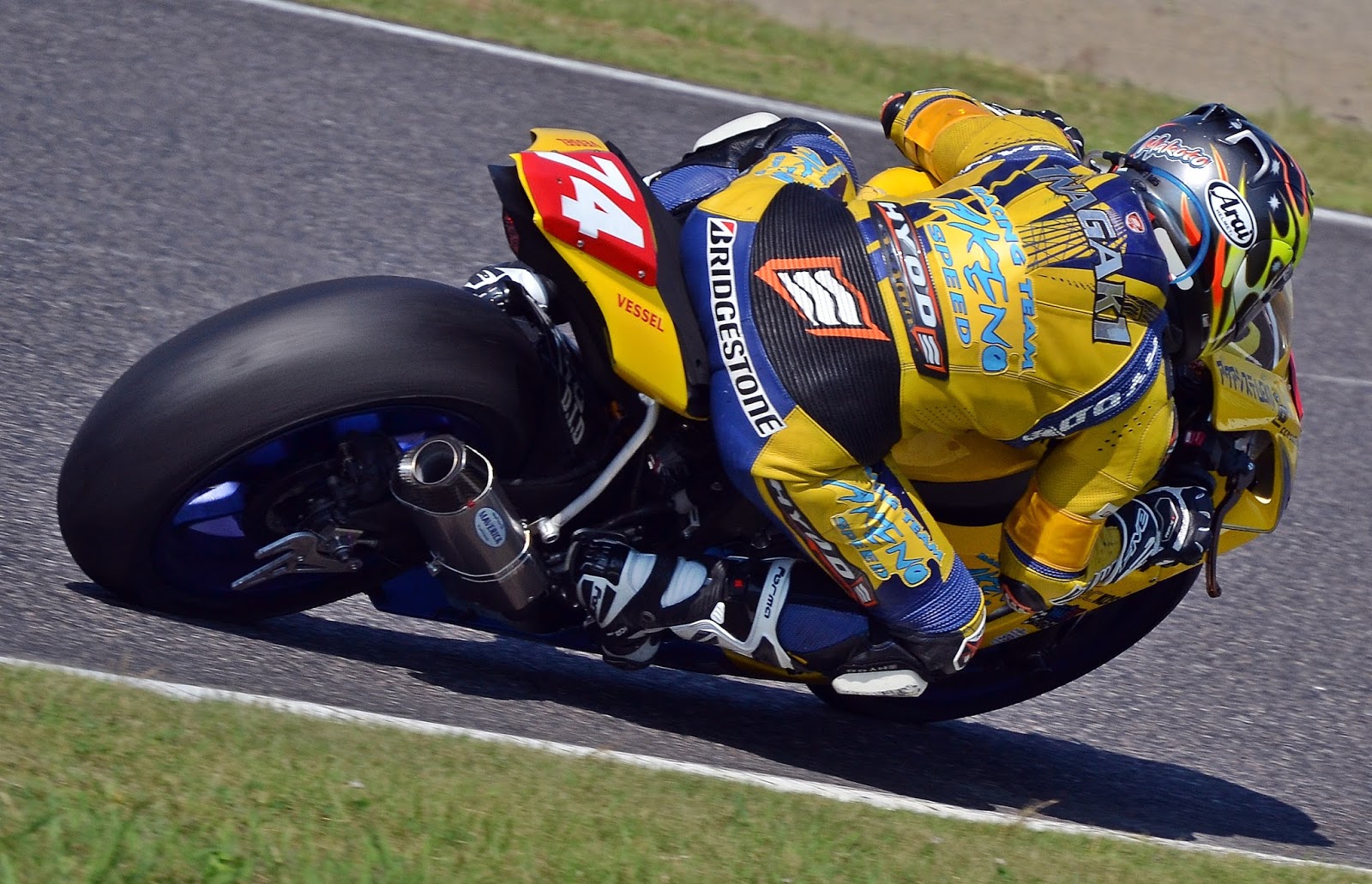
Makoto Inagaki on the Akeno Speed: WJR Yamaha YZF-R1 Superstock machine.