Sunday, September 10, 2017

In Praise Of Elias, Or It's Not Easy To Tame A Tiger

It is fashionable to cite the success of Toni Elias as proof of the dearth of talent in U.S. road racing. The mantra goes that Elias, a washed-up has-been, showed up on a MotoAmerica Superbike ride for Yoshimura Suzuki and casually beat the best of the U.S.

Toni Elias, MotoAmerica preseason testing, Circuit of the Americas, 2017.


This assessment is based on a short-sighted view of history and a lack of understanding as to how the business of racing works. Fact is that beating Toni on any given day is a challenge for anyone, not just in the U.S. but anywhere in the world.

Elias' speed is indisputable. Not only is he one of the few racers to beat a top-of-his-form Valentino Rossi, but he did so on a satellite machine. And Elias adapted to the new Moto2 series quickly, winning the first championship in that category. Speed is not the question.

Elias' reputation took a serious hit the following year when he went to MotoGP. Faced with the entirely different Bridgestone MotoGP tire after a season on the Moto2 spec Dunlop, Elias struggled to make the tires work. On his best days, he was mid-pack. On his worst, he was like Dani Pedrosa trying to get heat into the current spec Michelins - the tires simply gave him no grip, no feedback, and he struggled to get into the top 10. 

Switching back to Moto2 didn't help, and the underdeveloped Honda production MotoGP racer wasn't any friendlier. In racing, all you have are the results from last season, and Elias' results were literally nothing you wanted on your resume, especially given the heights he had ascended to. The top-level machinery that gets you wins simply wasn't made available to him.

In addition, Elias is a professional, with more than a decade of GP experience. In the post-economic-meltdown world, there were a lot of teams who could overlook Elias' speed, experience and talent and opt for a racer who would bring cash and sponsorship, rather than demand a paycheck. After earning a living doing something, it's hard to do it for free. It's a harsh-but-true estimate that on most grids, a third of the riders are getting paid, a third are doing it for free, and a third are paying for the privilege of racing. With no offers of paid rides, Elias sat, in his words, watching racing from the couch.

Many mistook this as European teams dismissing Elias' skills. Not true. They were dismissing his demands to be paid as a professional, compared to the extra value he could bring. Could Elias have scored mid-field or top 10 results in Moto2? Certainly. But why pay a rider for a 10th-place finish if you can have a rider bring the team money and finish 15th?

When Yoshimura Suzuki called, Elias was motivated. Yoshimura was a paying gig. Elias rewarded them with wins right off the bat on one of the oldest machines on the MotoAmerica grid - although, it must be said, a very well-sorted motor racing bike!

And that led to the 2017 season, with a very motivated Elias riding a brand-new GSX-R1000 that Suzuki had tested extensively in the off-season. Elias and teammate Roger Hayden both were more competitive than they had been, and Elias in particular gelled with the machine. Elias pushed hard; note the scuffed left hip of the leathers in the picture above. Elias dug deep into his well of experience and skill to earn the results he did.

The fact that Elias is the 2017 MotoAmerica Superbike champion isn't a damning indictment of the talent in the U.S. Rather, it could be viewed as the opposite. It took a rider who could win at the MotoGP level to defeat the U.S. riders, and even Elias had to push as hard as he could to make it happen.

Monday, September 4, 2017

Factory Proximity


Dan Linfoot, Honda Racing British Superbike Team, Druids Hairpin, British Superbikes, 2017. The flames erupting from the exhaust aren't just spectacular to look at. They hint at something deeper, something that is relevant to the very core of professional racing.


Linfoot, like most other professional racers on the new 2017 Honda CBR1000RR Fireblade, had struggled, with little in the way of help coming from Japan. At this round, he qualified third, led Race One and took his first podium of the season.

After the qualifying news conference, we spoke about a comment he'd made - that he'd gone to Japan to ride the Honda Fireblade put together by Moriwaki Motul Racing for the Suzuka 8 Hours. Linfoot had just gotten back from testing the bike, and he said he'd tried to get his team to make the BSB bike react like the Suzuka bike.

Linfoot said what he got most from the Suzuka test was a feeling that he wanted replicated in the BSB machine. Specifically, he wanted a smoother, more direct response to the throttle, which would make it easier for him to dial in the power and get out of turns more quickly. It is an axiom of racing of any sort: The pilota who gets on the power earliest wins.

"I told the team, the feel of the Suzuka bike - that's what I want this bike to feel like," Linfoot said.

The flame coming from the exhaust could be an indication that the team, unable to use electronics to dial in throttle response, had resorted to some old-time tuning techniques like richening the mixture to avoid lean on-off throttle response. It's crude and inefficient, but when you're banned from using more sophisticated techniques, you use what you've got.

Linfoot isn't the only Superbike rider who went to Japan and came back impressed by the machinery they rode, even though in some cases the spec of the Suzuka 8 Hours bikes were nearly identical to the spec of the machine they rode in series like World Superbike.

It is the phenomenon of Factory Proximity. Not all the information the factory knows leaves the building, the series or sometimes the country. As one BSB racer told me, "If Honda wanted to win World Superbike, they'd be winning World Superbike." Obviously, what Honda knows about making the new Fireblade competitive isn't transferring to Europe. 

Linfoot made it clear that the Honda at Suzuka was a much better machine. Alex Lowes liked the Suzuka 8 Hours Yamaha far better than his WorldSBK machine.

It is one of the fascinating subplots of racing, that information goes as far as it needs to go to achieve a company's greater goals. And winning at all costs isn't always the goal. To get that information, that data, that first-hand experience with the front-line weapon, the closer you get to the factory, the better.


Monday, August 28, 2017

Images Of Speed - 4

Been traveling a bit. Took my camera. Will be posting images of racing every now and then ...


Eugene Laverty, Milwaukee Aprilia Shaun Muir Racing RSV4, Turn 11, Mazda Raceway Laguna Seca, practice, Superbike World Championship 2017.


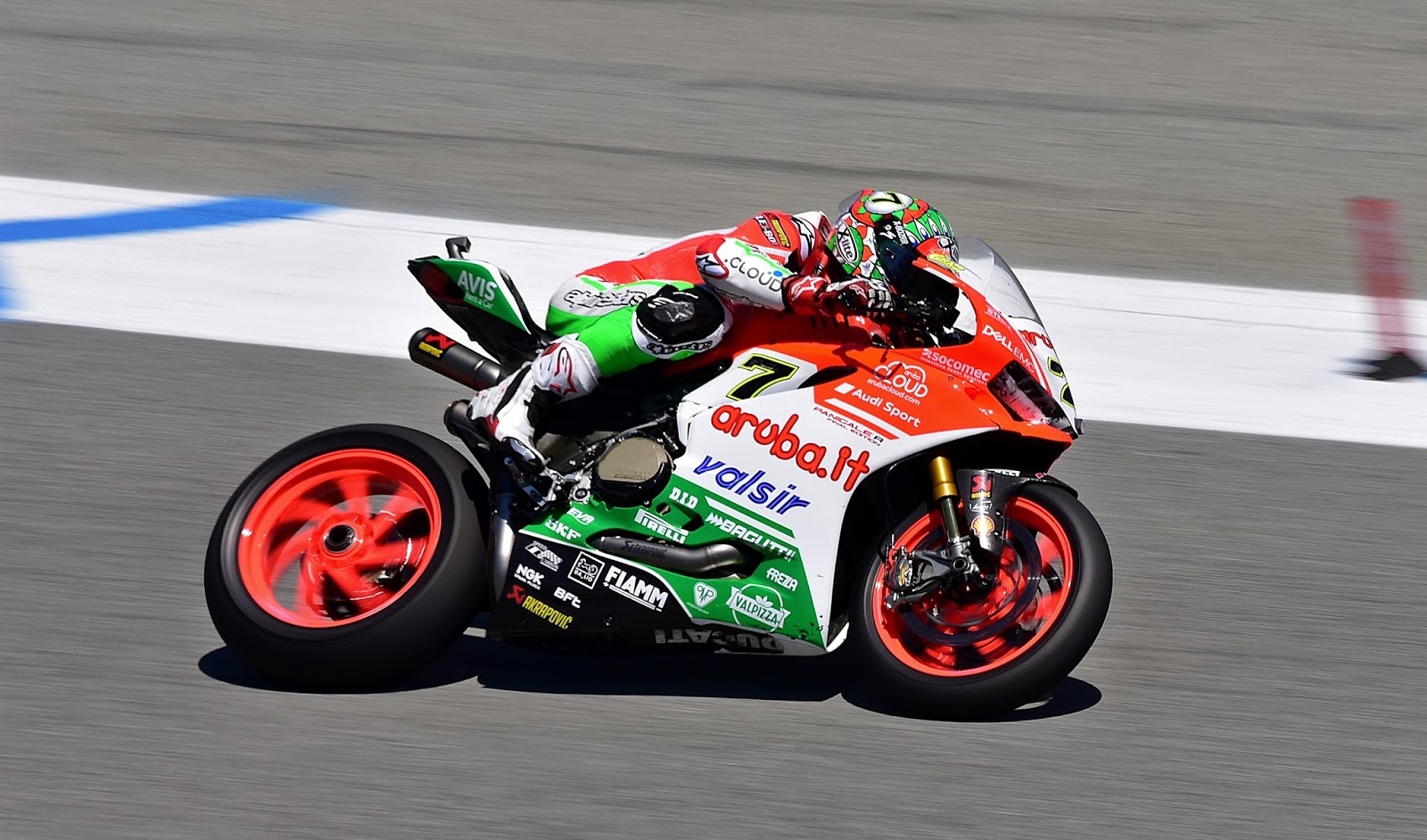
The factory Aruba.it Racing Ducati Panigale R racebikes wore special colors at Laguna.

Tom Sykes wheelies the factory Kawasaki Racing Team ZX-10RR up the front straight, Mazda Raceway Laguna Seca, practice, Superbike World Championship 2017.

Start of MotoAmerica Superbike Race Two, Turn Two, Mazda Raceway Laguna Seca, MotoAmerica 2017.


Tuesday, August 22, 2017

Images Of Speed - 3

Been traveling a bit. Took my camera ...

Superbike World Championship, Lausitzring, Germany, August 2017. This picture reflects the story of the season so far: Chaz Davies (7) and Jonathan Rea (1) battle for the lead in the opening laps of Race One, while Tom Sykes slots into third. On any given weekend, Rea and Davies are the two safest bets for the win. If you look carefully at the shot of Rea, you will note his more upright riding position, and that the top of his boot is on the ground.


It's about 30 feet tall, and it's the hospitality structure erected just behind the garages by the Milwaukee Aprilia team run by Shaun Muir Racing. To give you a sense of scale, the white-and-red structures at the edges of the picture are full-size cargo trailers. It's not just the tracks in Europe that are temples of speed, it's the effort that goes into a race weekend. Remember, this is the hospitality structure for a team that hasn't yet scored a podium.


From mid-race on, Davies was untouchable.


Nicky Hayden was in the paddock of WorldSBK for only a season and a half, but he was adopted by everyone there as one of their own. Look at the images of WorldSBK from the second half of this season, and note how many times Hayden iconography is visible.

Thursday, August 17, 2017

Images of Speed - 2

Been traveling a bit. Took my camera. Will post images of racing every now and then ...


Fans in paddock, Brands Hatch, British Superbike, July 2017.

 Shakey Byrne, Be Wiser Ducati Panigale R, Cooper Straight, Brands Hatch, British Superbike.

 John Hopkins, Moto Rapido Ducati Panigale R, Druids, Brands Hatch, British Superbike.


Michael Laverty, McAMS Yamaha YZF-R1, Clark Curve, Brands Hatch, British Superbike. I love this shot; the bike is barrelling toward me at about 100 miles an hour and will pass about three feet to my right, accelerating hard. The ground is thoroughly wet, so the riders have gone with full rains. As they cross the white grid marks painted onto the ground, the bike slips sideways. It's a corner that takes commitment and bravery under the best of circumstances; in these circumstances, it takes everything you've got to go fast.

Sunday, August 13, 2017

Images Of Speed - 1


Been traveling a bit. Took my camera. Will be posting images of racing every now and then ...

Image One: Me, Goddards Corner at Donington Park, Ron Haslam Racing School, Honda CBR600RR. Obviously, I didn't take that shot, but think of it as a byline for this series ...


Image Two: Chaz Davies, factory Aruba.it Racing Ducati Panigale R, Turn One, Mazda Raceway Laguna Seca, Race One, Superbike World Championship.


Image Three: Toni Elias, Yoshimura Suzuki GSX-R1000, front straight, Mazda Raceway Laguna Seca, Race One, MotoAmerica Superbike.


Image Four: Another of Toni Elias, Yoshimura Suzuki GSX-R1000, front straight, Mazda Raceway Laguna Seca, Race One, MotoAmerica Superbike. No one else in racing anywhere in the world made the new-for-2017 GSX-R1000 look as good as Elias.

Monday, August 7, 2017

Comfort Zone

Me, CBR600RR with full rain tires, Woodcote corner, Silverstone.


I have ridden on racetracks for 22 years and always managed to avoid riding in the wet. Recently, I had a choice: Ride the Silverstone Racing Circuit in the wet, or don't ride it at all. I chose the wet. I am happy I did, because I was able to watch the MotoGP round at Brno with entirely new eyes, an immense amount of respect for those who can go fast in the wet, and more than a little sympathy for Valentino Rossi.

Through chance and happenstance, I had my choice of two machines at Silverstone. For the first session - wet but not pouring - I chose the 2017 Yamaha YZF-R6. It was fitted with Pirelli Supercorsa tires - dry-weather DOT-certified racing rubber, with just enough grooves to make it legal for road use. The bike also comes stock with an immensely powerful system of electronic rider aids. I set the thing on full nanny mode - Power Mode B, Traction Control 4 - and headed out.

Even with those settings, the bike was - tricky. I could get it to twitch in a straight line, and there was no way to get any kind of confidence in the grip. I felt as though I was playing a video game, with virtually no feedback from the machine, and just spent the session blasting from corner to corner as rapidly as I could, then creeping around them at a snail's pace. That's not true. I think I saw a snail pass me once. And it gave me the finger.

Next session, track soaking and rain lashing down, I got on the Honda CBR600RR. A wonderful bike, yet a pale shadow of a new-generation R6. Cruder, slower, and no electronics at all. But it was mounted with full rain tires.

The difference in feel was - what is the term for the distance from zero to one? There was grip. I wasn't at dry condition lean angles by any stretch of the imagination. But I was able to brake ridiculously hard and to start feeding in the throttle far, far earlier than I would have imagined. I was able to drift the bike sideways over the painted grid lines exiting Woodcote, with a much greater level of confidence than I'd anticipated. For those conditions, the simple change of rubber made the greatest amount of difference, compensating for everything the CBR600RR lacked.

Dry pavement, dry-weather tires, all is right in the universe.

The track dried for the last session. I went back out on the R6, and I was immediately knee-down everywhere, confirming the positive dry-pavement performance of the Supercorsas. I left the track that day with a new, personal, visceral respect for the difference between rains and dry weather tires.

Arguments over whether Rossi waited too late to switch to the dry motorcycle at Brno aside, I can understand and feel why he made the choices he made. Rossi was leading the race, was faster, and the difference in the feeling between slicks and wets on a damp track is massive. Non-racers really don't grasp how tricky slicks can be to get to function - they're just tires, right? Hardly. At this level, they are insanely sensitive performance devices, rubber that will give you grip that your brain almost cannot process, yet will spit you off the machine if you go into a corner with the temperature of the tire just a few degrees out of its optimal operating range. A full-on racing slick (or DOT race tire) out of its operating temperature range is just flat spooky to ride on, even on a dry surface.

Part of the magic of Marc Marquez is that he's able to ride rapidly in those conditions, when the grip simply isn't there, sliding the machine around until the tires come up to temperature and the conditions improve.

Rossi? I understand why he clung to the rains for one more lap. The difference in feel, the confidence that a racer craves. The rains were giving him exactly what he wanted - reassurance and speed. And he knew what that out lap was going to feel like on the slicks. It was going to be the exact opposite. No racer wants that.

I can't empathize with the choice made by Rossi. All of the riders in MotoGP are professionals, I'm a hobbyist. And every one of them is so far beyond my level of capability that it's like they are governed by a different physics textbook than I am. 

But I can sympathize.