Tuesday, December 27, 2016
Wabi-sabi, Racebikes And No Reason
The movie "Rubber" begins with a monologue that centers on the concept of "no reason." Some things just are, for no reason that can be discerned. More important is to know when knowing the reason for something is completely unnecessary and detracts from the experience.
The Japanese wabi-sabi aesthetic's characteristics include "asymmetry, roughness, simplicity, economy, austerity, modesty, intimacy, and appreciation of the ingenuous integrity of natural objects and processes," according to Wikipedia.
I shot these images in the pits at a recent track day for vintage bikes and vintage riders. It is, I believe, a Honda CB160, gloriously unrestored and wearing its rust like a badge of honor. On any other track day, this bike would be ignored and unappreciated. On this day, between sessions, it was one of many machines that drew many appreciative visitors.
I am not Japanese.
I have many other things I should be doing.
So why am I posting these images here?
No reason.
If you are still with me, you completely understand.
Saturday, December 24, 2016
A Ronin Goes Home For The Holidays
Racing is like life; it has a beginning, a middle and an end. While the ascent of a racer's career is magnificent to watch, the descent can be painful. The slow drop down the order, less-competitive rides, and all too often injuries as the rider tries to capture with pure desperation and force what once came easily, can be sad to watch. The racer mentality, the outlook that gets you to the front, blinds you to the inevitable.
And of all the sports, racing can be the most ruthless and unforgiving when it comes to retaining the athlete. For the team, or the factory, there is no place to carry an underperforming rider, as any given rider is, typically, either half or all of the entire athletic department. Results are all that matters. And you're only as good as your last race. There's little room for emotion, or even doing the right thing; it's a matter of economics and performance.
So there is something that is touching when a factory finds a soft landing spot for a rider who is on the downward arc, a place for the rider to serve the vicious master of ambition and drive that makes them grid up, anywhere, anytime.
Ryuichi Kiyonari enrolled at nine years of age in the Suzuka Racing School junior program, the first student of that racing academy. Kiyo spent his early adolescence being trained as a road racing samurai for Honda. He graduated in 1995 at the age of 13. For 21 years now, he has raced. The racer's life is all that Kiyo has lived.
At the end of 2013, Honda called time on Kiyo's career, with the two not coming to terms on a new contract. At that point, had Kiyo retired, he would have been a success. He had won in World Superbike, won three British Superbike titles, and raced in MotoGP.
Instead, Kiyo left the Honda fold, shopped his services to BMW and Suzuki. He was a ronin, a warrior selling his services to the lord who needed him most. They were adequately successful partnerships; he is a popular figure in the BSB paddock and nearly took the title for BMW in 2014.
But it never felt right. Kiyo was raised by Honda, served Honda, and his BSB title-winning motorcycles were in Honda's collection at Motegi. It would have been somehow unsatisfying to see his career end with another manufacturer's logo on his leathers.
So for 2017, Honda and Kiyo are reunited. At the age of 34, it's likely Kiyo's last factory ride. He'll be racing in the All-Japan Road Race JSB1000 superbike class. And one gets the feeling that Honda made a space for him at the Superbike level, a way of thanking him for a career of representing the company well.
The ronin is home for the holidays.
And of all the sports, racing can be the most ruthless and unforgiving when it comes to retaining the athlete. For the team, or the factory, there is no place to carry an underperforming rider, as any given rider is, typically, either half or all of the entire athletic department. Results are all that matters. And you're only as good as your last race. There's little room for emotion, or even doing the right thing; it's a matter of economics and performance.
So there is something that is touching when a factory finds a soft landing spot for a rider who is on the downward arc, a place for the rider to serve the vicious master of ambition and drive that makes them grid up, anywhere, anytime.
Ryuichi Kiyonari enrolled at nine years of age in the Suzuka Racing School junior program, the first student of that racing academy. Kiyo spent his early adolescence being trained as a road racing samurai for Honda. He graduated in 1995 at the age of 13. For 21 years now, he has raced. The racer's life is all that Kiyo has lived.
At the end of 2013, Honda called time on Kiyo's career, with the two not coming to terms on a new contract. At that point, had Kiyo retired, he would have been a success. He had won in World Superbike, won three British Superbike titles, and raced in MotoGP.
Instead, Kiyo left the Honda fold, shopped his services to BMW and Suzuki. He was a ronin, a warrior selling his services to the lord who needed him most. They were adequately successful partnerships; he is a popular figure in the BSB paddock and nearly took the title for BMW in 2014.
But it never felt right. Kiyo was raised by Honda, served Honda, and his BSB title-winning motorcycles were in Honda's collection at Motegi. It would have been somehow unsatisfying to see his career end with another manufacturer's logo on his leathers.
So for 2017, Honda and Kiyo are reunited. At the age of 34, it's likely Kiyo's last factory ride. He'll be racing in the All-Japan Road Race JSB1000 superbike class. And one gets the feeling that Honda made a space for him at the Superbike level, a way of thanking him for a career of representing the company well.
The ronin is home for the holidays.
Wednesday, December 14, 2016
Vision
![]() |
| Gratuitous Nicky Hayden shot. |
Straight from the Saturday Night Specials shootout at a backwoods U.S. dirt track, the idea of putting fast riders behind slow riders at the start and hoping something interesting happens reeks of desperation and a lack of vision from the series organizers.
It is the height of hubris for an Internet blogger to say to the owners of a multi-million-dollar international corporation, "Well, here's what you should be doing with your property." Warning: Such hubris is coming in about three paragraphs.
But, first a word of sympathy. Prior to Dorna's purchase of the Superbike series, it was a direct competitor to GP racing. So it was relatively easy to take certain steps to build and maintain popularity. If the other series was doing well, steal everything you could from them, then add what was missing. See prime-time broadcast television, United States, history of.
Now Dorna owns both. And robbing from one to feed the other is a zero-sum proposition. So it's not just a matter of one series emulating the other to steal audiences. Dorna now needs to figure out how to sustain World Superbikes in a manner that doesn't take away from the popularity of MotoGP, and prop up MotoGP while keeping Superbike healthy.
OK, here's the hubris part. What Dorna needs is vision.
First, a hard look at what World Superbike offers that MotoGP can't. From the outside, it appears to be two things - lower costs and showroom relatability.
By racing production-based machines, the price of competing is reduced dramatically. You can, realistically, go racing for podiums, or at least top-six finishes, in Superbike for $100,000 per vehicle. You might - might - be able to do that in Moto2. Definitely not in MotoGP nor Moto3, where costs have escalated well beyond the initial intent of that class.
And by racing production-based machines, manufacturers can see a clear connection between what is raced on the track and what is sold to the public. This can leverage dealer, importer and distributor interest in the series.
Between the two, Superbike always will have a role. Companies will always want a showcase for their latest and greatest street machines. The lower cost of competing means that it doesn't take direct manufacturer involvement to put together a team to compete in the series. And if necessary, Dorna can prop up manufacturer involvement with subsidies, and get much more bang for the buck than in MotoGP.
The next step is to position World Superbikes as a placeholder. Trying to gather huge TV audiences is a mistake, a mistake that is understandable for Dorna to make because it is, essentially, a television production and promotion company. Superbike is the series you sell to the tracks that can't afford MotoGP, or when manufacturers want to race in a particular market. Do that, and you prevent another series - like, say, BSB - from coming in and staging races and stealing your audience. Sometimes, it's not about the profit you make, it's about the losses you avoid.
Short-sighted band-aids - inverted grids, naked bikes - work about as well as band-aids. They quickly fall off and stop doing any good. Dorna needs a long-term vision that understands that close racing is only part of the package. The AMA's old Harley 883 series had very close racing. It's dead. The Harley XR1200 series offered amazing-looking racing. It's dead.
Showcases for the latest and greatest streetbikes, rules that allow inexpensive modifications that bring bike performance closer, and a tight, packed weekend schedule that a racing fan can afford and understand are the things that bring in the audiences. Staying the course and building a solid platform with Superbikes in their proper place in the pantheon will do far more than gimmicks to make sure that in five years, Superbikes will not go the way of the XR1200 series.
Tuesday, December 6, 2016
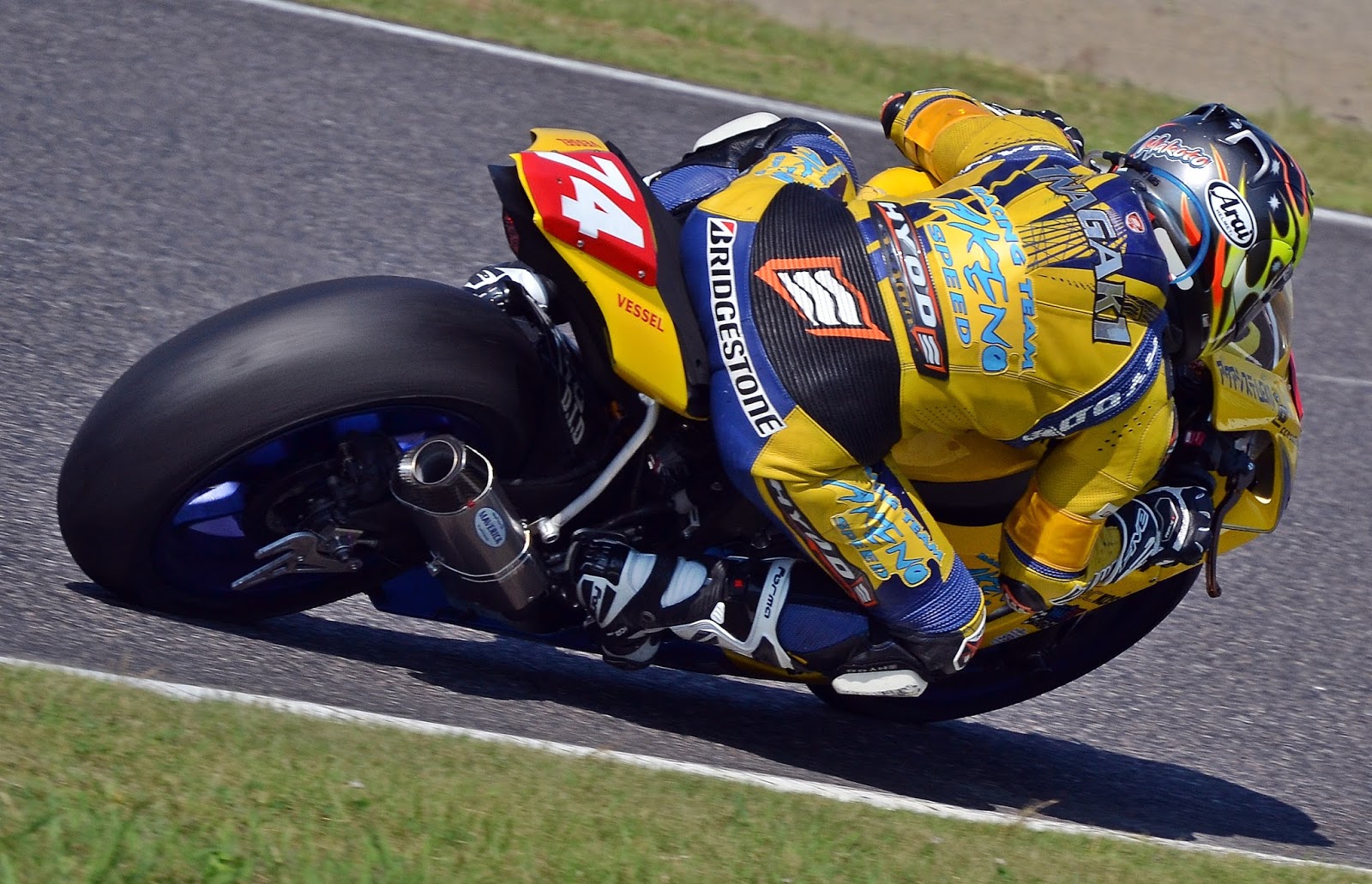
The Last Chicane: Photos From The 2016 Suzuka 8 Hours
The final corner of any track carries a special emotional meaning for a racer. On many circuits, a racer knows that leading out of the final corner usually means victory. For endurance racers, they know that the final corner means the end of their stint or the end of a long, hard race.
At Suzuka, the final chicane represents the end of a long, challenging lap. The 8 Hours machines slow to about 35 miles an hour and then the rider hammers the throttle, plunging downhill and accelerating to nearly 120 miles an hour in the final right-hand sweeper that leads onto the start/finish straight. It is a spot where photographers can catch the bikes and riders at full lean and relatively slow speeds, leading to amazing photos.
To purchase a copy of the "Suzuka 8 Hours 2016" book, click on the box to your right.
| Niccolo Canepa aboard the GMT94 Yamaha YZF-R1. |
At Suzuka, the final chicane represents the end of a long, challenging lap. The 8 Hours machines slow to about 35 miles an hour and then the rider hammers the throttle, plunging downhill and accelerating to nearly 120 miles an hour in the final right-hand sweeper that leads onto the start/finish straight. It is a spot where photographers can catch the bikes and riders at full lean and relatively slow speeds, leading to amazing photos.
To purchase a copy of the "Suzuka 8 Hours 2016" book, click on the box to your right.
| Akira Yanagawa on the Team Green Kawasaki ZX-10R. |
| Kazuhiro Kojima on the Japan Post-Honda Kumamoto Racing CBR1000RR. |
| Makoto Inagaki on the Akeno Speed: WJR Yamaha YZF-R1 Superstock machine. |
Wednesday, November 30, 2016
It Never Has To Happen ...
Finally, it looked like it was going to happen. Race Two of the Superbike World Championship event at Mazda Raceway Laguna Seca was all going Davide Giugliano's way. The longtime and loyal Ducati factory pilot had pushed his way past the dominant Kawasaki Racing Team ZX-10Rs of Jonathan Rea and Tom Sykes, and was starting to pull a gap when the red flag came out.
On the restart, Giugliano got into the lead again, but this time wasn't able to drop Sykes, who came past after three laps. Sykes is a master at late-braking and awesome corner exits, and that skill set allows you to hold off faster competitors at Laguna. Giugliano spent the last half of the race fending off teammate Chaz Davies while still trying to hunt down Sykes. In the end, Giugliano came in second, yet came up 0.209 seconds short of the win.
The race pretty much illustrated Giugliano's career in a nutshell. Undoubtedly fast, loyal and brave, Giugliano never managed to put the Ducati on top of the podium.
Fast is beyond a doubt. The 27-year-old Roman won the Superstock 1000 championship in 2011 and moved up to Superbike the next season. In 113 starts since, Giugliano earned five pole positions, eight fastest laps and 14 podium finishes. Nine times he finished second.
It is all the more impressive when you realize that when Giugliano started riding the Ducati, it was during the Bologna factory's darkest days in World Superbike. Giugliano was there during the company's longest winless drought in the series that it once owned. First he raced the 1098R during a period when it was hopelessly outgunned by the horsepower of the Aprilias and Kawasakis. Then he helped develop the Panigale through its teething phase, pushing the bike past its limits over and over in an attempt to put it on the box.
Let no one doubt Giugliano's bravery. He has missed several races due to back injuries. Potentially crippling back injuries. The kind of injury that makes racers shudder, the one thing that they keep locked in the deepest recesses of their minds, because if that thought escapes that little mental prison it is locked in, the racer's speed is gone. Racers commit suicide because of paralysis from racing injuries. Giugliano came back from back injuries - multiple times.
That desperate battle at Laguna took place one year after he crashed there and suffered a potentially career-ending back injury. Racers do things that leave mere mortals just slack-jawed. In many ways, they go places non-racers simply cannot even imagine.
But bravery and determination only go so far. Factories want results. Giugliano didn't deliver them. When he crashed at a sodden Lausitzring, his Panigale kept running for a bit while on its side. Then, Terminator 2-style, the tail light, required by the rain, blinks out. At that moment, Giugliano's World Superbike career was over.
He's got a new gig in British Superbike. Giugliano will be putting everything he has into it, putting his life on the line for a win. But it never has to happen.
On the restart, Giugliano got into the lead again, but this time wasn't able to drop Sykes, who came past after three laps. Sykes is a master at late-braking and awesome corner exits, and that skill set allows you to hold off faster competitors at Laguna. Giugliano spent the last half of the race fending off teammate Chaz Davies while still trying to hunt down Sykes. In the end, Giugliano came in second, yet came up 0.209 seconds short of the win.
The race pretty much illustrated Giugliano's career in a nutshell. Undoubtedly fast, loyal and brave, Giugliano never managed to put the Ducati on top of the podium.
Fast is beyond a doubt. The 27-year-old Roman won the Superstock 1000 championship in 2011 and moved up to Superbike the next season. In 113 starts since, Giugliano earned five pole positions, eight fastest laps and 14 podium finishes. Nine times he finished second.
It is all the more impressive when you realize that when Giugliano started riding the Ducati, it was during the Bologna factory's darkest days in World Superbike. Giugliano was there during the company's longest winless drought in the series that it once owned. First he raced the 1098R during a period when it was hopelessly outgunned by the horsepower of the Aprilias and Kawasakis. Then he helped develop the Panigale through its teething phase, pushing the bike past its limits over and over in an attempt to put it on the box.
Let no one doubt Giugliano's bravery. He has missed several races due to back injuries. Potentially crippling back injuries. The kind of injury that makes racers shudder, the one thing that they keep locked in the deepest recesses of their minds, because if that thought escapes that little mental prison it is locked in, the racer's speed is gone. Racers commit suicide because of paralysis from racing injuries. Giugliano came back from back injuries - multiple times.
That desperate battle at Laguna took place one year after he crashed there and suffered a potentially career-ending back injury. Racers do things that leave mere mortals just slack-jawed. In many ways, they go places non-racers simply cannot even imagine.
But bravery and determination only go so far. Factories want results. Giugliano didn't deliver them. When he crashed at a sodden Lausitzring, his Panigale kept running for a bit while on its side. Then, Terminator 2-style, the tail light, required by the rain, blinks out. At that moment, Giugliano's World Superbike career was over.
He's got a new gig in British Superbike. Giugliano will be putting everything he has into it, putting his life on the line for a win. But it never has to happen.
Sunday, November 20, 2016
Farewell To A Racing Boss
Shuhei Nakamoto joined HRC's MotoGP program at a time when neither he nor Honda were on a winning streak. In MotoGP, although Honda had taken the rider championship with Nicky Hayden in 2006, the company had been schooled by Yamaha for several seasons, first with Valentino Rossi, then with Jorge Lorenzo.
While wins came Honda's way every season, and podium positions were frequent, it had been a long time since HRC looked like its rider would end the season atop the points. Hayden's championship, which came as a result of solid finishes, not domination, was the first since Rossi left, and in the seasons to follow, the handful of victories was not what the company wanted. Corporations go racing to demonstrate their superiority, and superiority wasn't being reflected in the results table or in the headlines.
It was worse - way worse - in Formula One. In 2006, Nakamoto was named Senior Technical Director for the company's Formula One program. According to various reports at the time, Nakamoto inherited a car that was marginally capable, with one win in 18 starts, and a wind tunnel that was broken. 2007 saw Honda score no podiums in F1 competition, and 2008 saw only one.
It was the nadir of Nakamoto's career with Honda. He'd been with the company since his late 20s, and had devoted his professional life to Honda and motorcycle road racing. He joined the company in 1983, and was quickly assigned to the RS125 and RS250 GP bike projects. During his tenure, the Honda became a consistent race winner, a bike that was always a threat to win a World Championship. From 1984 to 1996, Honda won 11 125cc and 250cc GP World Championships.
In 1997, he was named Large Project Leader for Honda's World Superbike competitor, the RVF750, which immediately took John Kocinski to the title and Honda to the manufacturer championship. It was the first Superbike championship for Honda since the formative years of the series and Fred Merkel's back-to-back titles on an RC30. Annoyed by a rules structure that many felt favored Ducati's V-twins, in 2000 Honda put Nakamoto in charge of a V-twin project of its own, the VTR1000SP, better known as the RC51. It won the title the first time out with Colin Edwards aboard, and won again in 2002.
Nakamoto was not a man who took losing well, and he knew how to go hunting for titles at the highest levels of motorcycle road racing. 2009, Nakamoto's first season at the helm, was all about Yamaha. In 2010, longtime HRC MotoGP soldier Dani Pedrosa suddenly doubled the number of wins from the previous season. The next year, Honda poached Casey Stoner from Ducati and immediately won the MotoGP title. With Stoner injured for much of 2012, Pedrosa came within a tire warmer malfunction of winning the championship. These were the performances that made a manufacturer look good. Honda's machinery was so good that fans of the sport wailed like infants that the racing was boring because of the amazing job HRC had done with its bike and its team.
For the whiners, it got worse.
Stoner retired, but Honda had laid claim to one Marc Marquez, who proceeded to then take three of the next four MotoGP titles, and the one he didn't win he finished with the second-highest number of wins. Nakamoto knew that it was the combination of machine and man that won titles, and Marquez could help an under-performing machine look better than it was.
Nakamoto is leaving HRC, retiring due to his age. HRC has named three people to do his job. It is a testament to his leadership, and a loss to the sport to have such a single-minded individual leave the paddock. When Nakamoto showed up, it was to kick ass, make Honda look good and chew bubble gum, and someone invariably forgot the bubble gum.
Two comments from Nakamoto illustrate why he deserves the title of Racing Boss:
Back when the whining about "boring" racing was reaching a fevered pitch in 2012, Nakamoto was asked about the entertainment MotoGP provided. His comment was simple: This was of no concern to Honda. Winning was what mattered, not bread and circuses for the minions.
When Rossi left Honda and won titles with Yamaha, he was famously quoted as saying that the rider mattered more than the machine. When Rossi fell flat on his face at Ducati, Nakamoto took the opportunity to kick him when he was down. "After he (Rossi) left Honda, has written a book, saying that the driver has more of the bike. Now it has to prove it," Nakamoto told GPOne.
The joy of sport is that it is unfettered competition where the goal is to prove that you are the best. Under Nakamoto's reign, Honda was so dominant that many claimed the company would destroy MotoGP. It's perhaps the highest praise you can offer Nakamoto for a lifetime of service to his company and his dedication to racing's highest ideal - winning.
While wins came Honda's way every season, and podium positions were frequent, it had been a long time since HRC looked like its rider would end the season atop the points. Hayden's championship, which came as a result of solid finishes, not domination, was the first since Rossi left, and in the seasons to follow, the handful of victories was not what the company wanted. Corporations go racing to demonstrate their superiority, and superiority wasn't being reflected in the results table or in the headlines.
It was worse - way worse - in Formula One. In 2006, Nakamoto was named Senior Technical Director for the company's Formula One program. According to various reports at the time, Nakamoto inherited a car that was marginally capable, with one win in 18 starts, and a wind tunnel that was broken. 2007 saw Honda score no podiums in F1 competition, and 2008 saw only one.
It was the nadir of Nakamoto's career with Honda. He'd been with the company since his late 20s, and had devoted his professional life to Honda and motorcycle road racing. He joined the company in 1983, and was quickly assigned to the RS125 and RS250 GP bike projects. During his tenure, the Honda became a consistent race winner, a bike that was always a threat to win a World Championship. From 1984 to 1996, Honda won 11 125cc and 250cc GP World Championships.
In 1997, he was named Large Project Leader for Honda's World Superbike competitor, the RVF750, which immediately took John Kocinski to the title and Honda to the manufacturer championship. It was the first Superbike championship for Honda since the formative years of the series and Fred Merkel's back-to-back titles on an RC30. Annoyed by a rules structure that many felt favored Ducati's V-twins, in 2000 Honda put Nakamoto in charge of a V-twin project of its own, the VTR1000SP, better known as the RC51. It won the title the first time out with Colin Edwards aboard, and won again in 2002.
Nakamoto was not a man who took losing well, and he knew how to go hunting for titles at the highest levels of motorcycle road racing. 2009, Nakamoto's first season at the helm, was all about Yamaha. In 2010, longtime HRC MotoGP soldier Dani Pedrosa suddenly doubled the number of wins from the previous season. The next year, Honda poached Casey Stoner from Ducati and immediately won the MotoGP title. With Stoner injured for much of 2012, Pedrosa came within a tire warmer malfunction of winning the championship. These were the performances that made a manufacturer look good. Honda's machinery was so good that fans of the sport wailed like infants that the racing was boring because of the amazing job HRC had done with its bike and its team.
For the whiners, it got worse.
Stoner retired, but Honda had laid claim to one Marc Marquez, who proceeded to then take three of the next four MotoGP titles, and the one he didn't win he finished with the second-highest number of wins. Nakamoto knew that it was the combination of machine and man that won titles, and Marquez could help an under-performing machine look better than it was.
Nakamoto is leaving HRC, retiring due to his age. HRC has named three people to do his job. It is a testament to his leadership, and a loss to the sport to have such a single-minded individual leave the paddock. When Nakamoto showed up, it was to kick ass, make Honda look good and chew bubble gum, and someone invariably forgot the bubble gum.
Two comments from Nakamoto illustrate why he deserves the title of Racing Boss:
Back when the whining about "boring" racing was reaching a fevered pitch in 2012, Nakamoto was asked about the entertainment MotoGP provided. His comment was simple: This was of no concern to Honda. Winning was what mattered, not bread and circuses for the minions.
When Rossi left Honda and won titles with Yamaha, he was famously quoted as saying that the rider mattered more than the machine. When Rossi fell flat on his face at Ducati, Nakamoto took the opportunity to kick him when he was down. "After he (Rossi) left Honda, has written a book, saying that the driver has more of the bike. Now it has to prove it," Nakamoto told GPOne.
The joy of sport is that it is unfettered competition where the goal is to prove that you are the best. Under Nakamoto's reign, Honda was so dominant that many claimed the company would destroy MotoGP. It's perhaps the highest praise you can offer Nakamoto for a lifetime of service to his company and his dedication to racing's highest ideal - winning.
Saturday, November 12, 2016
The 2016 WERA West Yearbook Now Available
The 2016 WERA West Yearbook, featuring more than 130 full-color images, race reports, results and complete class championship standings from the 2016 WERA West season, now is available. Images and words by motojournalist Michael Gougis, 62 pages, soft bound. Retail cost is $29.95 plus shipping and handling. Order from Lulu.com at:
Or order directly from the author at morbidelli17@yahoo.com, 626.221.7466. Please allow four weeks for delivery.
Thanks to the supporters who made this project possible:
Friction Racing Products: http://frictionracingproducts.com/
A.G. Assanti & Associates: http://www.bike911.com/
M Racing Performance: http://www.mracingperformance.com/
R.Tillery Powersports: http://rtillery.com/
Tony Serra
Subscribe to:
Posts (Atom)