Saturday, July 29, 2017

Sport Touring, BMW, And Nirvana

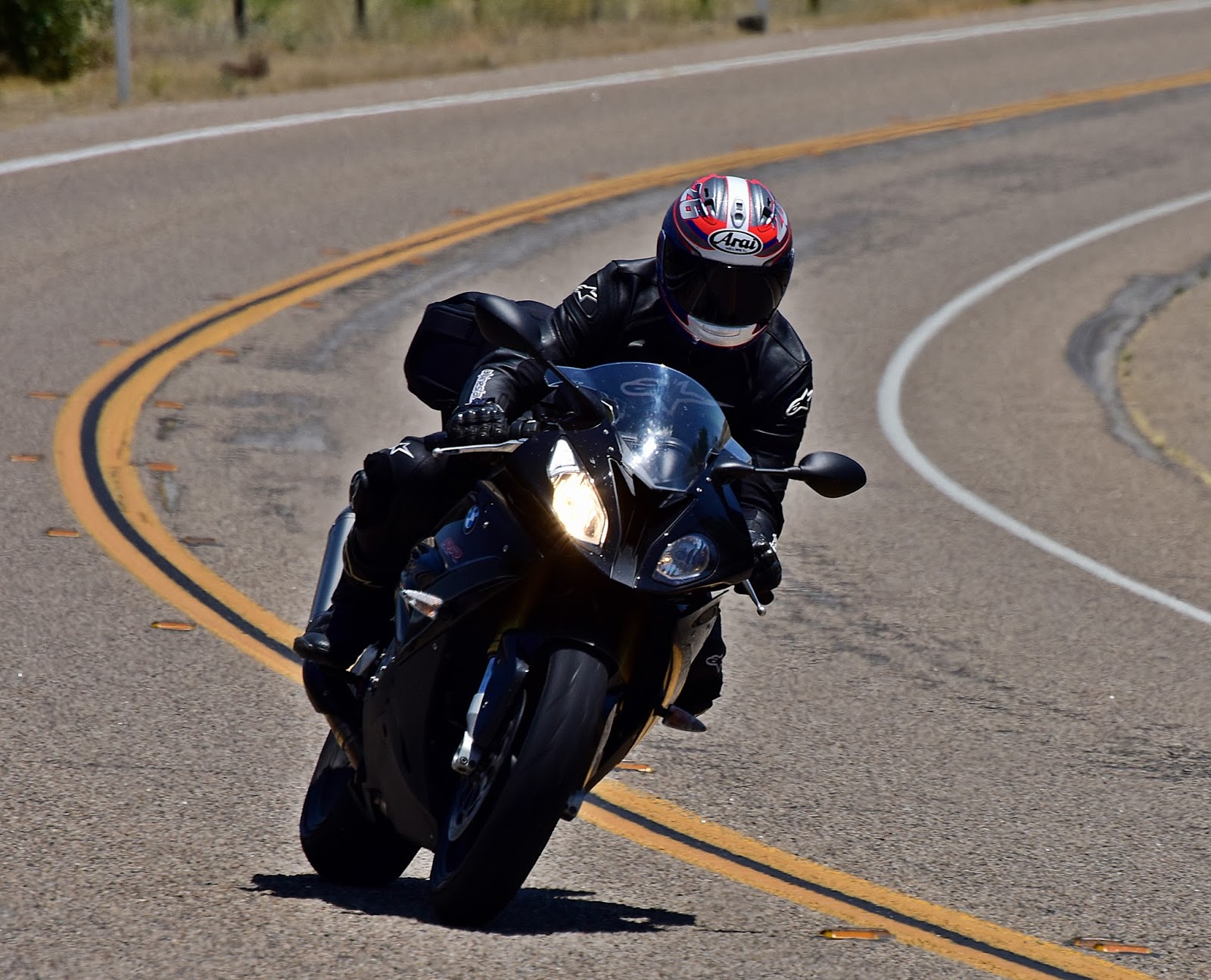
Kevin Williams has done the 800-mile round trip to Laguna Seca for years on his BMW S1000RR. Photos by Michael Gougis.
I know these roads. I have ridden them from my earliest days of riding. They are the asphalt capillaries away from the highways that link Southern to Northern California, the two-lane roads that offer an escape from the beaten path.

For decades now, I've ridden them for weekend getaways, for motorcycle road evaluations, and every spring for a visit to Mazda Raceway Laguna Seca to watch the world's best roadracers on one of the most iconic circuits in the world.

They offer everything that the roads can throw at a rider. There are wide-open spaces that test the ultimate power of the fastest machines - there is a reason that BMW brought us here, years ago, to sample the K1300S, at the time the most powerful motorcycle BMW ever had produced. There are tight, twisty sections, long, open sweepers, and if you are so inclined, you can jump onto long stretches of freeway to get you between Point A and Point B in as little time as possible.

At the end of a day on these roads, you feel like you have put in a full day of riding. Your skills are sharper, your knowledge of your machine more intimate, and your appreciation for the art of motorcycling never will be greater.

For the 27th year, the same group of friends joined me for the annual ride up to Laguna, this time to watch the Superbike World Championship and MotoAmerica races. This year, I wanted to do the ride on a machine that would, at first glance, seem to be out of its element. It's easy to focus on the sporting elements of the BMW S1000RR. Hard to overlook nearly 190 horsepower at the rear wheel, semi-active suspension, massive disc brakes, dynamic traction control, and a riding position that looks like something off a Superbike grid.

But the fact is that more than nine out of ten Supersports machines sold in the U.S. never are taken onto the track. They are used on the streets, as weekend thrill machines, as commuters, and even as long-distance touring bikes. Look at the parking lot at the WorldSBK races, and there are lots and lots of sportbikes with soft luggage attached.

I have, in my library, Ian Falloon's book on the history of the iconic BMW R90S. The machine was praised for its ability to compete with the best on the track and perform the role of gentleman's express on the highway. So, the question here is simple: Can the finely honed blade of the S1000RR cut it in the role of touring bike? From the saddle of BMW's most advanced, most powerful and fastest motorcycle ever, can you feel the ghosts of the R90S?

Paddock, Mazda Raceway Laguna Seca, the turnaround point for the trip.
The Route:

Fire up the 101 in heavy traffic out of the Los Angeles basin. Overnight at a friend's house, where each year dinner gets a little longer and the boots-up time gets a little later.

First up is the two-lane Highway 33 past Ojai, away from the coast and up over the mountains toward the great central plains of the state. This road has everything - blind, tight switchbacks with the occasional rock and shale on the verges, long, sweeping turns with clear lines of sight for half a mile, and long, long stretches of straights that look like they were drawn on a map with a ruler.

Drop down onto Highway 166, where the temperature is soaring. More two-lane highways get you over a high-speed mountain pass with broad, wide-open corners that clearly were drafted by a sportbike rider who had infiltrated the state transportation department. Into Taft for fuel, where the temperatures have soared well into triple-digits. Back onto Highway 33, onto a long, straight two-lane highway populated by big trucks and farming equipment, bisecting vast expanses of oil drilling rigs and empty land.

Up to Highway 58, more tight, twisting two-lane asphalt with dramatic elevation changes thrown in. One stretch of straight pavement is just a series of blind crests, so steep that the other side is hidden. Even after riding that same road for so many years, the experience never fails to amaze me. A few more fast sweepers, then split up to Paso Robles for lunch, then a straight shot up the Highway 101 to Monterey, battling the vicious crosswinds through the vast agricultural tracts north of Greenfield. By the time the sidestands go down in Monterey, it's been more than 278 miles since Ventura.

This portion of the ride tested both the sporting and touring capabilities of the machine. Loaded with a camera, a computer, running gear and everything else I'd need on a long weekend, the S1000RR carried a full complement of tank bag, passenger seat bag and saddlebags. But the machine didn't seem to notice while riding at a pace that was appropriate for public roads – but quite far toward the enthusiastic end of that range!

Highway 33 and a respite from the heat.
Sporting:

The Metzeler RRacetecs provided more than enough grip for anything I care to do in a corner, and the electronic rider aids really prove their value in real-world riding. I left everything on Sport mode, where the ABS just sort of sits in the corner and lets you get on with the task of braking (which is really just setting your corner entry speed) comfortable in the knowledge that if something untoward appears on the road without you seeing it, the machine has your back. In addition, the anti-wheelie and anti-slip allow you to get on the throttle enthusiastically, and if you cross the line, the machine once again keeps you out of trouble. This allowed me to more thoroughly enjoy the ride, accelerating harder out of corners with less worry. It really is amazing how unobtrusive the system is in street riding. When I'd dial in too much throttle for the available grip at the lean angle I was at, the machine just sort of gathered speed a little more slowly than the right hand wanted, then when all was well, picked up its skirts and flat flew.

Clutchless shifting is one of those things that once you experience it, you're thinking, why did it take them so long? Accelerating out of fast corners, grabbing gears as you go, is seamless and doesn't upset the chassis when leaned over, the power on hard. And clutchless downshifting means one less thing to think about when entering a corner. That is, really, the advantage of clutchless downshifting to racers: More of their brain is available for braking, turning and leaning. The more brain available for that, the better (read, faster and more accurately) it can be done. And it works the same way on a two-lane highway.

In short: The bike is a missile. The electronic rider aids make all of that capability accessible to you.

Jordi Torres on the Althea World Superbike S1000RR. Torres has just crested the hill after the short straight at Laguna, is traveling approximately 160 miles an hour, is knee-down, the bike touching the pavement so lightly after the crest that you can hear the traction control modulating the throttle to provide maximum power and speed for the grip available. Standing at this spot, watching and knowing what is happening on the bike is powerful proof of how well modern electronic rider aids work.
Touring:

What I found most interesting was that the technology incorporated into the bike for the purposes of getting it around a racetrack more quickly paid big dividends while touring on the bike.

As on most long rides, comfort becomes a major factor on the way home. For me, that meant 371 miles straight, almost all on the 101, from Monterey to the far eastern corner of Los Angeles County.

After two days of watching the races at Laguna, we chose to head home on Sunday night to try to avoid the worst of the heat. It was only partly successful, as it was still well over 100 degrees at 5 in the afternoon. I recall thinking, as we rode south and the sun sank, that it couldn't possibly get any hotter, that eventually it was bound to cool down, and then rounding a corner past a foothill only to find that yes, actually, it could get hotter, thank you very much. Then, after fueling at Atascadero, the temperature plummeted more than 40 degrees and into the high 50s as we approached Pismo Beach and the Pacific Ocean, shot back into the 90s a few moments later as our route brought us back inland toward Santa Maria, and stayed there nearly the entire way home. It was still almost 90 degrees when I pulled into my garage at 10:45 p.m.

Little things normally associated with reducing lap times made such a mile-eating grind far, far less unpleasant. Clutchless shifting made dealing with traffic a one-handed affair, not that you needed to do a lot of shifting with the torque and flexibility of the S1000RR motor. I first experienced an S1000RR on a test ride when the machine first was introduced, and all these years later the engine still thrills, every time. 

Sylvain Barrier
ABS took even more stress out of traffic. (And yes, while ABS isn't normally associated with racetrack use, the fact is that modern ABS systems would likely get most club racers around a circuit more quickly. Old superstitions die hard.)

Add in a couple of touring-oriented features like the heated grips and cruise control, and the bike becomes a pleasant place to spend a couple of hours without stopping. The electronic cruise control on the S1000RR is nice and accurate, and gave me peace of mind while stretching my right hand for a moment or two.

Not that my wrists, back or legs ached much. On a modern sportbike, the bars are low, but the machine is so short (for agility on the track) that the reach to them is not far. The S1000RR's seat was well-padded, the pegs high but not cramped for my 5' 10” frame, and the sporting fairing does a decent job of deflecting the wind.

Six hours straight on a cutting-edge sportbike platform capable of winning National-level Superbike races (see Jordan Szoke, the dominant rider in the CSBK Canadian Superbike Championship on the Mopar Express Lane BMW Superbike Team S1000RR) was a lot more pleasant than it had any right to be. The proof, to me, was that when I got home after that six-hour, 371-mile ride, I just got off the bike, unloaded it, took off the luggage, wiped it down, showered and went to bed. The next morning, I felt like I could do it again – and wanted to.

Epilogue:

There was a moment on the ride up, in one of those big, fast, wide-open sweepers. My friend Kevin was ahead of me on his 2015 S1000RR, Chuck behind on his 2016 S1000RR. I was following Kevin closely enough that I could feel the turbulence left behind by his machine slicing through the air. Leaned over, knee out, upper body cranked into the wind for a proper cornering position, the wind noise and exhaust note providing the final sensory elements of a symphony of speed. The S1000RR was in its element; loaded with luggage and hundreds of miles into the trip, perfectly settled and stable, power pouring through the rear tire, giving me everything a sport-touring rider could want, and I actually thought: I wish I could live right here, in this moment, all the time.


Monday, July 3, 2017

The Cutting Courses


Ondrej Vostatek is 12 years old. He's been racing since he was six years old, has won mini road racing championships in the Czech Republic and in Germany. He's raced in the Czech Republic, Germany, Italy, Holland and Spain.

Vostatek has raced Honda NSF100s and Moto4 machines - twin-spar aluminum framed machines powered by 25-horsepower Honda CRF150 engines cranking out 25 horsepower and weighing 165 pounds.

Now he's competing in the FIM CEV Repsol European Talent Cup series on a Honda NSF250R, a 250cc four-stroke single with a GP twin-spar frame, a bike that kicks out 46 horsepower and weighs 185 pounds.

That is the specification of the machine Vostatek races.

He's one of 29 riders competing in the entire series. The teams competing in the series have direct links to the teams competing in MotoGP and are funded by some of the same companies whose logos appear on the fairings of MotoGP machines. MotoGP factory rider Alex Rins runs a team in the series.

That is the level of competition Vostatek races at.

He's 12.

And he's not the youngest rider in the class.


There is a term that first-year law students quickly learn. It is the phrase "Cutting Course." These are the courses that are designed to weed out the students who will not  be successful lawyers. They are wicked-hard, and the instructors are merciless. The point is to allow only the most talented to proceed. The rest are cut.

Spain is the Cutting Course of motorcycle road racing. Much has been written about how the Spanish domination of Grand Prix racing is bad for the sport. But the fact is that no country has made motorcycle road racing its national sport in the way that Spain has.

No country has institutionalized the care and feeding of young racers quite the way that Spain has. There are institutions and academies where young, young children spend hours and hours riding pocketbikes around cones while instructors bark information at them. Want your youngster to train with the father of five-time World Champion Jorge Lorenzo? You can enroll him or her in the Lorenzo Competition schools at the age of two.

Two.

No country has an infrastructure designed to give young races a step-by-step ladder of machinery quite like Spain has. Take, for example, the BeOn Automotive company's line of GP machinery, starting with 25-horsepower GP machines with twin-spar chassis and moving up to Moto3 spec bikes. And they are not the only company doing so in Spain.


While you can find similar companies and schools elsewhere in the world, what you are unlikely to find is ferocity of the competition at such a young age. The FIM CEV Repsol series posts full-length videos of its races on YouTube. The races are well worth watching - the kids in the European Talent Cup and the Moto3 classes race like if they don't win, they don't eat. And if they succeed there, they have at least a chance of making the jump to professional International racing. There's no guarantee that they'll succeed. But it's hard to think of a racer who's failed in Spanish youth road racing and then gone on to success at the higher levels.

Some of the countries in Asia are starting to put together similar systems. The Asia Talent Cup races are - and have been for a while - spectacular, although their success at putting their graduates into International competition has been limited to date.

MotoAmerica has, undoubtedly, saved professional road racing in the United States. But one of the reasons given for its formation was to create a clear path to International level racing and to groom talent in the States for racing at that level. It's not enough to simply clear the path. It has to start much, much earlier than the KTM RC Cup series and Superstock 600 racing.

Think of it this way: By the time Vostatek is 14, he'll have had three seasons in the European Talent Cup on the NSF250R, fighting against nearly 30 other riders backed by International-level teams. He could move up to a full-blown, aluminum GP-chassis Moto3 machine with about 50 horsepower, where the bike and rider combined weigh as little as 329 pounds, and test his skills against the packed, factory-supported Moto3 fields in the CEV series.

In the U.S., riders 14 years old who want to compete at the FIM CEV Repsol-equivalent level, MotoAmerica, would find themselves racing a 38-horsepower bike with a trellis steel frame that weighs 304 pounds by itself - rider not included. And they'll be racing fields that are about half the size of the Moto3 CEV fields.

When those racers turn 16, graduates of which series will find GP team managers calling?

A clear path is only one step. To be successful, one has to be able to follow the path.

Friday, June 23, 2017

WERA West, Round Three, Vegas, Baby! Part Three

More pictures from Round Three of the WERA West event at Las Vegas Motor Speedway:


Christopher De La Torre.


Ken Pfister leads Armen Manougian, Brad Saenz, Terry Heard and Mookie Wilkerson.


Anas Sorhmat leads Matt Warnert.


Harm Jansen.

Wednesday, June 21, 2017

The Factory Effect

Jonathan Rea's string of victories to start the 2017 season sparked a (predictable, it must be said) cry among some quarters of the roadracing community that the Superbike World Championship needed help. The racing was too boring, the results predictable, etc. Never mind how close some of the victories were, never mind how much effort Rea and team had put into winning. Never mind how hard Chaz Davies and Ducati have been pushing Kawasaki. Never mind that the points table masks just how close the races actually have been.

For a world with an ever-decreasing attention span and an insatiable appetite for greater and greater stimulation, changes were needed to keep WorldSBK a viable enterprise, the argument went.

And just as predictably, the same simplistic suggestions on how to "level the field" were trotted out - at least, some of them. Problem for the complainers is that some of the obvious have been tried - and have failed to solve the perceived "problem."

The spec tire rule in World Superbike has been a success and a failure, depending on which year you look at, in terms of the outcome of races and the closeness of the finishes. There are a lot of positives to a spec tire approach, and generally Pirelli has done a spectacular job with a very difficult task, but obviously there are other factors that play as great or greater a role in determining the closeness and variety of race results.

Another simplistic suggestion is the tried-and-tired call for "spec electronics." Many motorcycle road racers and Technology Prima Donnas share a common trait, which is, to quote Scott Adams, the creator of the "Dilbert" cartoon empire, "an obsessive preference for old technology." The motorcycle version of this is a comment that I've heard muttered in paddocks: "If it wasn't on a Norton featherbed it's no good ..."

For this audience, computers and electronics are witchcraft and sorcery, the racing world would be a better place if they never had been invented, and banning ECUs and throwing them all into Mount Doom would bring about Nirvana.

Enough people bought into this specious argument that MotoGP now uses specified hardware, software and sensors. The impact has been exactly what many people (including myself) predicted: Virtually none.

The difference between the races in the relatively unfettered ECU era of MotoGP and the current era can be found primarily in Michelin's struggle to develop tires for the class. This process means that the company is bringing a wide variety of rubber to the track, constantly changing the compounds and constructions, and the teams can't develop their bikes around the tires because they are a moving Michelin target.

Throw in some unpredictable weather, some tracks where the surface is dirty, and you get some unpredictable finishes. But to conclude that the spec ECU made MotoGP racing closer is to mistake causation for correlation, the same sort of logic that resulted in many, many virgins being chucked into volcanos to make sure the sun rose in the morning.

No reason to take my word for it. Here's what Ducati's Ernesto Marinelli told bikesportnews.com recently about the proposal for a spec ECU in World Superbike:

"In any case a control ECU in MotoGP has been applied over the last couple of years and it doesn’t really change much on the performance of the bikes or the diversity of the manufacturer,” said Marinelli, speaking to bikesportnews.com. “Of course, if you put the same platform on every team, you have the guarantee everyone has the same potential but in the end the performance on the track is not only the electronics but the dynamics of the bike, the performance of the engine, the ability to set up the bike and having the best rider.

"Honestly, I think little bit levelling the potential of the electronics will not be that effective on downgrading the high-performing teams or upgrade the lesser-performing ones."

So if it's not tires, it's not electronics, what makes the factory Kawasaki and Ducati teams so dominant in World Superbike?

Call it the Factory Effect.

In a recent podcast posted at roadracingworld.com, Jonathan Rea pointed out that the ZX-10RR sold in the dealership incorporates feedback from world-level racers, and very specifically himself. The bike is designed around the feedback from Rea and Tom Sykes, the winners of three of the last four Superbike titles. They test the machine, and they don't just bring it back into the pits to change compression damping. Rea and Sykes fly to Japan to talk to the people who draw the machine. Their feedback alters the fundamental design of the bike. That's not marketing fluff. To misquote Ricky Bobby, 'cause that just happened.

Compare that to the approach of Honda in World Superbike and elsewhere, where the development of the new CBR1000RR has been left to the race shops or the individual teams. Kawasaki is punching race-oriented ZX-10RRs off the production lines. Honda is making streetbikes (and CBR1000RRs are really, really amazing streetbikes) but the Honda race teams are trying to keep up on their own with the development of Kawasaki's factory.

The results that you see at the track are exactly what you'd expect, given that scenario. Kawasaki runs up front, Honda struggles at the back. Effort equals results.

One of the really fascinating things about this, though, is that it's not just in WorldSBK that Kawasaki does so well. Think about it: The closer the bike is to race-ready when it comes off the assembly line, the less there is to do to it and the closer a lesser-funded team can get to the front.

There's a reason that Tech3 runs Yamaha and LCR runs Honda in MotoGP. The bikes are good, close to front-line factory spec, so while the initial investment is significant, they have the ongoing financial capability of fielding a machine that is competitive. How much would it cost a satellite team to make the Aprilia or KTM competitive in MotoGP? Honestly, no one knows, because not even the factories there have gotten it right yet.

But you look at privateer Bobby Fong in MotoAmerica, racing a Kawasaki ZX-10 in Superstock trim with no support from Kawasaki and giving some of the Superbike teams absolute fits on the track. You look at the teams that run Kawasaki in British Superbikes, and given a machine that incorporates the feedback from riders as amazing as Sykes and Rea, they're also running at the front.

Two things to wrap this up:

The Factory Effect is so powerful that in two widely different configurations, the ZX-10RR is a race-winning beast. In WorldSBK, electronics are as unfettered as they are anywhere in the world. In BSB, there's a spec ECU with no traction control. In both series, Kawasaki riders sit 1-2 in the points table.

In both series, the two machines that are closest to race-ready from the factory - the ZX-10RR and the Ducati Panigale R - sit at the top of the charts. And if you want to really drill into the facts, consider the standings in WorldSBK and British Superbike as of today, June 21, 2017.

Chaz Davies and his Ducati Panigale R (with full electronic rider aids) sat in third place in World Superbike points, with 185, compared to the 296 points of leader Jonathan Rea on the Kawasaki ZX-10RR. Davies has 62.5 percent of the points scored by Rea.

Shakey Byrne and his Ducati Panigale R (with no rider aids) sat in third place in British Superbike points, with 90, compared to the 141 points of leader Luke Mossey on the Kawasaki ZX-10RR. Byrne has 63.8 percent of the points scored by Mossey.

Racing works in mysterious ways.

Thursday, June 8, 2017

WERA West, Round Three, Vegas - Part Two

More images from the WERA West round , May 2017, Las Vegas

 Ron Gentile.


 Yuri Barrigan.

 Brian Morris.

Wednesday, June 7, 2017

WERA West, Round Three - Vegas

Photos from the May 2017 WERA West round in Las Vegas:

David Guerrero.


Sahar Zvik.


Christopher Carron.


Erick Vizcaino.

Monday, June 5, 2017

Speaking Ducati

The names of Jorge Lorenzo and Marco Melandri are preceded by an honorific few humans ever will be known by: Grand Prix World Champion. Lorenzo has a title in every Grand Prix class in which he has participated; Melandri won the 250cc GP title in 2002. Melandri has finished second in the MotoGP championship with multiple wins on a satellite machine. Lorenzo has 44 wins in MotoGP alone to his name.
Point is, these two know how to ride a roadracing machine.

Second point: Both of them are having their hindquarters served to them on a silver platter by their teammates.

The names of Andrea Dovisioso and Chaz Davies are well-known to race fans, but they are not rated nearly as highly as Lorenzo, who rides alongside Dovi in MotoGP, and Melandri, who joined Davies on the Aruba.it Racing Panigale for 2017. Dovisioso, the 2004 125cc GP Champion, has fewer MotoGP race wins than Melandri, despite riding for the factory teams of Honda and Ducati and starting more MotoGP races than Melandri. Davies has spent most of his career on production-based machinery, and his only World Championship came in World Supersport.

And yet, so far, Dovisioso has a win and a second in MotoGP this season, while Lorenzo has taken a single third place. Since the end of 2010, Ducati has three MotoGP wins; Dovi has two of them. In the Superbike World Championship, Davies has eight podiums to Melandri’s six, but only Davies has won (twice) while several of Melandri’s podiums have come in races where Davies has crashed.

Third point: All four of these riders race Ducati.

What is the difference between the race-winning journeymen and the struggling superstars? At its core, the difference is that Dovi and Davies have learned to speak the language of Ducati.

Learning this language did not happen overnight. And perhaps it only happened because Davies and Dovi were kind of forced to.

Dovisioso only spent his third season on the Repsol Honda factory team because he had a contract that required Honda to provide him a factory bike if he met certain performance criteria. Honda had signed Casey Stoner and wanted Dovi to go away. Dovi reminded Honda of its contract, and to its credit, Honda gave him a factory bike for 2011. But at the end of the year, with Stoner and Dani Pedrosa already signed and Dovi out of contract, the Italian had to shop around for work. Dovi spent a year on the Tech3 satellite Yamaha, but was getting older and factories weren't returning his phone calls. And when Valentino Rossi bailed on Ducati, it wasn't like riders were lining up to ride the machine that Rossi couldn't tame, the machine that had a reputation as a career-killer. Ducati needed a rider; Dovi needed a factory ride.

Here's what Dovi chose to do/was allowed to do that no other Ducati factory rider has since: He stayed with Ducati. Teammates came and went, but Dovi was a faithful partner to Ducati. And he showed that he was married to the factory, for better or for worse, at the beginning of 2015. Even after no wins, one pole and two podiums in 2013 and 2014 combined, Andrea showed up at the pre-season test at Qatar with a diagram of the desmodromic valve gear stenciled across the butt of his leathers, alongside his new married name, "Desmo Dovi."

From that point on, Dovi wasn't thinking about whether the Ducati was better or worse than other bikes. It was all about learning to ride the Ducati MotoGP machine that he had between his legs at that moment. He wasn't going anywhere else; this was the bike he had, and he had committed to racing this machine as best he could.

That meant learning the bike intimately, figuring out how to read the inputs from a bike that was so different than other MotoGP bikes that riders like Rossi, Melandri, Nicky Hayden and Cal Crutchlow never quite unraveled the language that the bike spoke. That meant learning to speak back to the machine in a language that no other MotoGP bike responded to. Over the years, Dovi and the Ducati have come to know each other, and Dovi can, it is fair to say, whisper into the bike's ear and convince it to do things that no other rider - even a rider as supernaturally talented as Lorenzo - can get the bike do.

Davies found himself looking for a ride after his BMW factory Superbike World Championship team disappeared after the 2013 season. And once again, the factory Ducati team wasn't exactly desirable for riders looking for race-winning machinery. After Carlos Checa won 15 races in 2011 to take the World Championship for Ducati, the outdated 1098R took Checa to only four wins in 2012, and the new Panigale was such a poor racebike that Checa scored no wins in 2013 and quit the sport.

Davies didn't immediately drag the Panigale into the winner's circle, but he did score four podiums in 2014. The next season was better, with 18 podiums and five wins, followed by 2016 with 11 wins for the Panigale. So far, Davies is the only rider to take a Panigale across the finish line first in Superbike World Championship competition. And if the first job of a professional racer is to beat your teammate, Davies has accomplished that beyond any question.

Davies and Dovi are in long-term relationships with the unique machines that come from Bologna. Each has developed an ability to communicate with their racebikes in a way that their new-to-the-relationship teammates haven't quite nailed down yet. Given enough time, there isn't any reason that Lorenzo and Melandri won't be able to match or exceed the performance of Dovi and Davies.

But right now, there are no two riders anywhere on the planet who speak better Ducati.